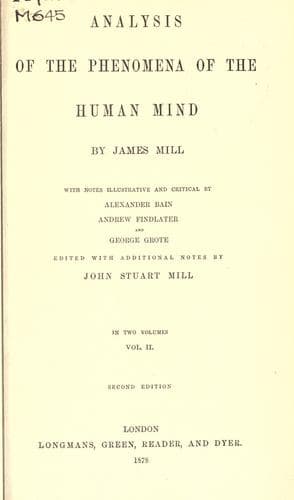
Analysis of the Phenomena of the Human MindMill, James
PhilosophyPhilosophy
Analysis of the Phenomena of the Human Mind
Mill, James
Psychology
It is also of extreme importance to mark a great defect and
imperfection, in this respect, of the Latin language. Such words as
_lectio_, _dictio_, _actio_, are derived with equal readiness either
from the supine, _lectum_, _dictum_, _actum_; or from the
participle, _lectus_, _dictus_, _actus_. The supine is _active_, the
participle, _passive_. From this circumstance probably it is, that
{308} these abstract terms in the Latin language possess both the
active and passive signification; and by this most unfortunate
ambiguity have proved a fertile source of obscurity and confusion.
This defect of the Latin language is the more to be lamented by us,
that it has infected our own language; for as we have borrowed from
the Latin language a great proportion of our abstract terms, we have
transplanted the mischievous equivocation along with them. This
ambiguity the Greek language happily avoided: thus it had [Greek:
pra=xis] and [Greek: pra=gma] the first for the active
signification of _actio_, the latter the passive.[85]
[Editor's footnote 85: I apprehend that [Greek: pra=gma] is not an
abstract but a concrete term, and does not express the attribute of
being done, but the thing done--the effect which results from the
completed action.--_Ed._]
Of the abstract terms, of genuine English growth, derived from the
concrete names of action, or verbs, the participle of the past tense
supplied a great number, merely dropping the adjective, and assuming
the substantive form. Thus, weight, a word which we had occasion to
notice before, is the participle weighed, with the connotation
dropped: stroke is merely struck; the _thing_ struck, the
connotation, being left out: thought is the past participle passive
of the verb to think, and differs from the participle in nothing,
but that the participle, the adjective, has the connotation; the
abstract, the substantive, has it not. Whether the concrete, or the
abstract, is the term employed, is in such cases always indicated by
the context; and, therefore, no particular mark to distinguish them
is required.
{309} In our non-inflected language, a facility is afforded in
forming a non-connotative from the connotative, in the active voice
of verbs; because the connotative word is always distinguished by
the presence of the persons of the verb, or that of some part of the
auxiliary verb. The same word, therefore, answers for the abstract,
as for the concrete; it being of course the abstract, when none of
the marks of the concrete are present. Thus the word love, is both
the verb or the connotative, and the substantive or the
non-connotative; thus also fear, walk, ride, stand, fight, smell,
taste, sleep, dream, drink, work, breath, and many others.
Public-domain text, read in full here on John Shaqi.
Reviews
Reviews
No reviews yet
Be the first to share your thoughts on this work.
Elsewhere in the archive
Join the Discussion
Join the discussion
Sign in to leave a comment or review.
Sign InorCreate an account