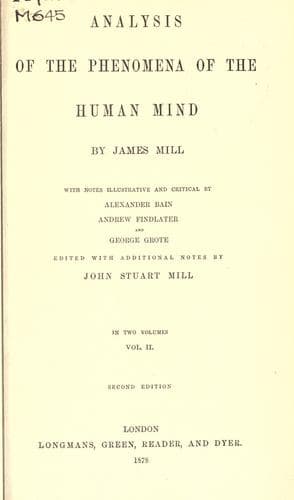
Analysis of the Phenomena of the Human MindMill, James
PhilosophyPhilosophy
Analysis of the Phenomena of the Human Mind
Mill, James
Psychology
But an observation of the greatest importance readily occurs; that
of any cluster, composing our idea of an object, the effects or
consequents depend, in general, more upon one part of it than
another. If a stone is hot, it has certain effects or consequences;
if heavy, it has others, and so on. It is of great importance to us,
in respect to those successions, to be able to mark discriminately
the real antecedent; not the antecedent combined with a number of
things with which the consequent has nothing to do. I observe, that
other objects, as iron, lead, gold, produce similar effects with
stone; as often as the name _hot_ can, in like manner, be predicated
of them. In the several clusters therefore, hot stone, hot iron, hot
gold, {315} hot lead, there is a portion, the same in all, with
which, and not with the rest, the effects which I am contemplating
are connected. This part is marked by the word _hot_; which word,
however, in the case of each cluster, connotes also the other parts
of the cluster. It appears at once, how much convenience there must
be in dropping the connotation, and obtaining a word which, in each
of those cases, shall mark exclusively that part of the cluster on
which the effect depends. This is accomplished by the abstract or
non-connotative terms, heat, and weight.
Certain alterations, also, are observed in those parts of clusters
on which such and such effects depend; which alterations make
corresponding alterations in the effects, though no other alteration
is observable, in the cluster, to which such parts belong. Thus, if
a stone is more or less hot, the effects or successions are not the
same; so of iron, so of lead; but the same alteration in the same
part of each of those clusters, is followed by the same effects. It
is true, that we know nothing of the alteration in the cause, but by
the alteration in the effects; for we only say that a stone is
hotter, because it produces such other effects, either in our
sensations immediately, or in the sensations we receive from other
objects. It is, however, obvious that we have urgent use for the
means of marking, not only the alterations in the effects, but the
alterations in the antecedents. This we do, by supposing the
alterations to be those of increase and diminution, and marking them
by the distinction of lower and higher degrees. But, for this
purpose, it is obvious that we must have a term which is not
connotative; because we suppose no alteration in any {316} part of
the cluster but that which is not connoted; thus we can say, with
sufficient precision, that a greater or less degree of heat produces
such and such effects; but we cannot say, that a greater or less
degree of hot stone, of hot iron, of hot any thing else, produces
these effects.
This then, is another use, and evidently a most important use, of
abstract, non-connotative terms. They enable us to mark, with more
precision, those successions, in which our good and evil is wholly
contained.
Public-domain text, read in full here on John Shaqi.
Reviews
Reviews
No reviews yet
Be the first to share your thoughts on this work.
Elsewhere in the archive
Join the Discussion
Join the discussion
Sign in to leave a comment or review.
Sign InorCreate an account