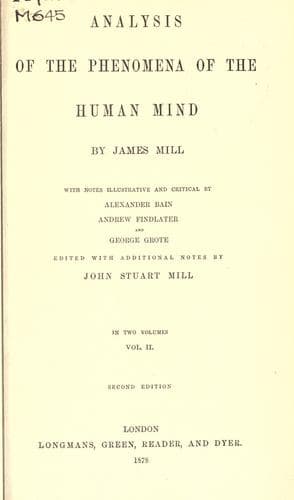
Analysis of the Phenomena of the Human MindMill, James
PhilosophyPhilosophy
Analysis of the Phenomena of the Human Mind
Mill, James
Psychology
Even if our ideas were associated in trains, but only as they are in
Imagination, we should still be without the capacity of acquiring
knowledge. One idea, upon this supposition, would follow another.
But that would be all. Each of our successive states of
consciousness, the moment it ceased, would be gone for ever. Each of
those momentary states would be our whole being.
Such, however, is not the nature of man. We have states of
consciousness, which are connected with past states. I hear a
musical air; I recognise it as the air which was sung to me in my
infancy. I have an idea of a ghost; I recognise the terror with
which, when I was alone in the dark, that idea, in my childish
years, was accompanied. Uniting in this manner the present with the
past, and not otherwise, I am susceptible of knowledge; I am capable
of ascertaining the qualities of things; that is, their power of
affecting me; and of knowing in what circumstances what other
circumstances will take place. Suppose that my present state of
consciousness is the idea of putting my finger in the flame of the
candle. I recognise the act as a former act;[87] and this
recognition is followed {320} by another, namely, that of the pain
which I felt immediately after. This part of my constitution, which
is of so much importance to me, I find it useful to name. And the
name I give to it is MEMORY. When the memory of the past is
transferred into an anticipation of the future, by a process which
will be explained hereafter, it gets the name of experience; and all
our power of avoiding evil, and obtaining good, is derived from it.
Unless I remembered that my finger had been in the flame of the
candle; and unless I anticipated a similar consequent, from a
similar antecedent, I should touch the flame of the candle, after
being burned by it a hundred times, just as I should have done, if
neither burning nor any of its causes had ever formed part of my
consciousness.
[Bain's footnote 87: The recognition of an act as a former act, or
of a present sensation as having formerly occurred, is a
*phase of the intellectual power named consciousness of Agreement,
or Similarity, which is both an essential of our Knowledge, and a
means of mental Reproduction. The defectiveness of the author's
view of this function of the intellect has been elsewhere commented
on.--_B._]
Our inquiry is, what this part of our constitution, so highly
important to us, is composed of. All inquirers are agreed, that it
is complex; but what the elements are into which it may be resolved,
has not been very successfully made out.
Public-domain text, read in full here on John Shaqi.
Reviews
Reviews
No reviews yet
Be the first to share your thoughts on this work.
Elsewhere in the archive
Join the Discussion
Join the discussion
Sign in to leave a comment or review.
Sign InorCreate an account