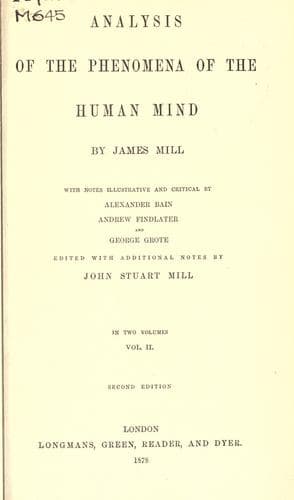
Analysis of the Phenomena of the Human MindMill, James
PhilosophyPhilosophy
Analysis of the Phenomena of the Human Mind
Mill, James
Psychology
A very remarkable application of this principle offers itself to our
contemplation, in the artificial memory which was invented by the
ancient orators and rhetoricians. The orator made choice of a set of
objects, sufficient in number to answer his purpose. The ideas of
those objects he taught himself, by frequent repetition, to pass
through his mind in one constant order. The objects which he chose
were commonly such as aided him in fixing them according to a
certain order in his memory; the parts, for example, of some public
building, or other remarkable assemblage. Having so prepared
himself, the mode in which he made use of his machinery was as
follows. The topics or sentiments of his speech were {325} to follow
in a certain order. The parts of the building he had chosen as his
instrument had previously been taught to follow by association, in a
certain order. With the first of these, then, he associated the
first topic of his discourse; with the second, the second, and so
on. The first part of the building suggested the first topic; the
second, the second; and each another, to the end of his
discourse.[89]
[Bain's footnote 89: The conditions of the success of this expedient
are interesting to study as illustrations of the working of
association. The supposition is that the parts of the building are
perfectly coherent in the mind, that they can recall each other
easily and rapidly. The advantage gained will depend entirely upon
the superior facility of attaching a head of discourse to the
visible appearance of a room, as compared with the facility of
attaching it to a previous head. If we can form an enduring bond
between a topic and the picture of an interior, by a smaller mental
effort than is necessary to conjoin two successive topics, there is
a gain by the employment of the device; the difference of the two
efforts is the measure of the gain. Probably the result would depend
upon the relative force of the pictorial and the verbal memory in
the individual mind. In minds where the pictorial element prevails,
there might be a positive advantage; in cases where the pictorial
power is feeble and the verbal power strong, there would almost
certainly be a dead loss.--_B._]
Public-domain text, read in full here on John Shaqi.
Reviews
Reviews
No reviews yet
Be the first to share your thoughts on this work.
Elsewhere in the archive
Join the Discussion
Join the discussion
Sign in to leave a comment or review.
Sign InorCreate an account