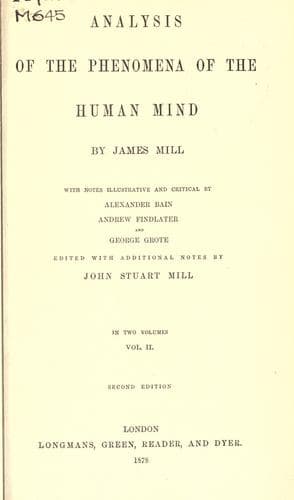
Analysis of the Phenomena of the Human MindMill, James
PhilosophyPhilosophy
Analysis of the Phenomena of the Human Mind
Mill, James
Psychology
There are two cases of Memory. One is, when we remember sensations.
The other is, when we remember ideas. The first is, when we remember
what we have seen, felt, heard, tasted, or smelt. The second is,
when we remember what we have thought, without the intervention of
the senses. I remember to have seen and heard George III, when
making a speech at the opening of his Parliament. This is a case of
sensation. I remember my conceptions of the Emperor Napoleon and his
audience, when I read the account of his first address to the French
Chambers. This is a case of ideas.
{329} We shall consider the case of sensations first. What is it to
remember any thing I have seen?
First, there is the idea of it; and that idea brought into existence
by association.
But, in Memory, there is not only the idea of the thing remembered;
there is also the idea of my having seen it. Now these two, 1, the
idea of the thing, 2, the idea of my having seen it, combined, make
up, it will not be doubted, the whole of that state of consciousness
which we call memory.[91]
[Editor's footnote 91: The doctrine which the author thinks "will
not be doubted" is more than doubted by most people, and in my
judgment rightly. To complete the memory of seeing the thing, I must
have not only the idea of the thing, and the idea of my having seen
it, but the belief of my having seen it; and even this is not always
enough; for I may believe on the authority of others that I have
seen a thing which I have no remembrance of seeing.--_Ed._]
But what is it we are to understand by what I have called "the idea
of my having seen the object?" This is a very complex idea; and, in
expounding, clearly, to the comprehension of persons, not familiar
with these solutions, the import and force of a very complex idea,
lies all the difficulty of the case.
It will be necessary for such persons to call to mind the
illustrations they have already contemplated of the remarkable case
of association, in which a long train of ideas is called up so
rapidly as to appear but one idea; and also the other remarkable
case, in which one idea is so strongly associated with another, that
it is out of our power to separate them. Thus, when we use the word
battle, the mind runs over the {330} train of countless acts, from
the beginning of that operation to the end; and it does this so
rapidly, that the ideas are all clustered into one, which it calls a
battle. In like manner, it clusters a series of battles, and all the
intermediate operations, into one idea, and calls it a campaign;
also several campaigns into one idea, and calls it a war. Of the
same nature is the compound idea, which we denote by the word year;
and the still more compound idea, which we denote by the word
century. The mind runs over a long train of ideas, and combines them
so closely together, that they assume the appearance of a single
idea; to which, in the one case, we assign the name year, in the
other, the name century.
Public-domain text, read in full here on John Shaqi.
Reviews
Reviews
No reviews yet
Be the first to share your thoughts on this work.
Elsewhere in the archive
Join the Discussion
Join the discussion
Sign in to leave a comment or review.
Sign InorCreate an account