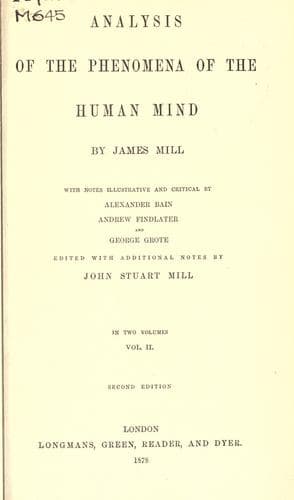
Analysis of the Phenomena of the Human MindMill, James
PhilosophyPhilosophy
Analysis of the Phenomena of the Human Mind
Mill, James
Psychology
If we contemplate forgetfulness, not memory, we shall see how
completely the account of it confirms the account we have just
rendered of memory. Every {332} case of forgetfulness, is a case of
weakened, or extinct, association. Some years ago, I could repeat a
certain discourse with accuracy and ease, from beginning to end;
attempting it, the other day, I was unable to repeat more than a few
sentences. The reason is obvious. The last of the words and ideas
which occurred to me failed to suggest the following; that is to
say, the association which formerly existed between them was
dissolved.
A remarkable piece of natural scenery, composed of mountains, woods,
rivers, lakes, ocean, flocks, herds, cultivated fields, gay
cottages, and splendid palaces, of which I had a lively recollection
many years ago, presents itself to me now very much faded: in other
words, a great variety of the circumstances, which make up the
detail and minute features of the scene, were formerly remembered by
me, but are now forgotten. And how forgotten? The manner is obvious.
The greater features, which I still remember, had formerly the power
of calling up the smaller along with them, and the whole scene was
revived; the association gradually declining, the great objects have
no longer the power to excite the idea of the small; and they are
therefore gone from me for ever.
There are things of which I have so entirely lost the recollection,
that it never can be revived. The meaning is, that the associations
which were formed between the ideas of them, and other ideas, are so
completely dissolved, that none of my present ideas has the power of
exciting them.
It is observable, that sensations have a stronger power to excite
recollections than is possessed by {333} ideas.[92] A man, after an
absence of many years, revisits the scenes of his infancy: a variety
of circumstances crowd into his memory, which, but for the scene
before him, would never have been remembered again. These are the
circumstances between which, and the perception of the pristine
objects, the association is not yet dissolved. There are other
circumstances, without number, which (the association being
completely dissolved) not even that perception can revive, and which
never can be remembered more.
[Bain's footnote 92: This is for no other reason than the superior
intensity or impressiveness of the actual as compared with the
ideal. Although as a rule, the sensation has a greater hold of the
mind, than the corresponding idea, there are exceptions. An idea may
sometimes be accompanied with an intensity of mental occupation and
excitement, surpassing the reality: what we have looked at with
indifference when it occurred, may take on an extraordinary
importance in the retrospect; in which case its power of
resuscitating collateral circumstances will be far greater than the
power of the original sensation.--_B._]
Public-domain text, read in full here on John Shaqi.
Reviews
Reviews
No reviews yet
Be the first to share your thoughts on this work.
Elsewhere in the archive
Join the Discussion
Join the discussion
Sign in to leave a comment or review.
Sign InorCreate an account