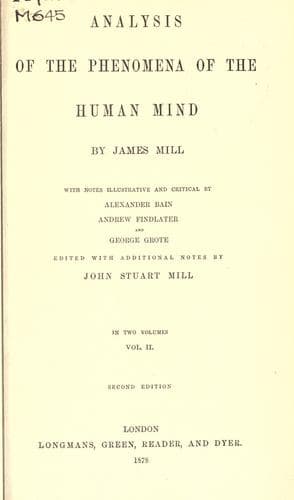
Analysis of the Phenomena of the Human MindMill, James
PhilosophyPhilosophy
Analysis of the Phenomena of the Human Mind
Mill, James
Psychology
[Bain's footnote 101: This is true in by far the greater number of
instances. Nevertheless, there are some of the signs of feeling that
have an intrinsic efficacy, on very manifest grounds. While the
meanings of the smile and the frown could have been reversed, if the
association had been the other way, there is an obvious suitability
in the harsh stunning tones of the voice to signify anger and to
inspire dread, and a like suitability in the gentle tones to convey
affection and kindly feeling. We might have contracted the opposing
associations, had the facts been so arranged, just as in times of
peace, we associate joy with deafening salvos of artillery; and as
loud, sharp-pealing laughter serves in the expression of agreeable
feeling. But there is a gain of effect when the signs employed are
such as to chime in, by intrinsic efficacy, with the associated
meanings. On this coincidence depend the refinements of elocution,
oratory, and stage display.--_B._
[The fact here brought to notice by Mr. Bain is, that certain of the
natural expressions of emotion have a kind of analogy to the
emotions they express, which makes an opening for an instinctive
interpretation of them, independently of experience. But if this be
so (and there can be little doubt that it is so) the suggestion
takes place by resemblance, and therefore still by
association.--_Ed._]]
[Mill's footnote 10: "It has been very justly remarked, that if all
men had uniformly spoken the same language, in every part of the
world, it would be difficult for us not to think [believe] that
there is a natural connexion of our ideas, and the words which we
use to denote them."--_Brown_, _Lectures_, ii. p. 80. 2d ed.]
The process of our Belief in this case, then, is evidently, as
follows. Our sensations are inseparably associated with the idea of
our bodies. A man cannot think of his body without thinking of it as
sensitive. As he cannot think of his own body without thinking of it
as sensitive, so he cannot think of another man's {358} body, which
is like it, without thinking of it as sensitive. It is evident that
the association of sensitiveness is more close with certain parts of
the complex idea, our bodies, than with other parts; because the
association equally follows the idea of horse, of dog, of fowl, and
even of fish, and insect: and it will be found, I think, that there
is nothing with which it is so peculiarly united as the idea of
spontaneous motion. What is the reason we do not believe there is
any sensation in the most curiously-organized vegetable; while we
uniformly believe there is in the polypus, and the microscopic
insect? Nothing whatsoever can be discovered, but a strong
association which exists in the one case, and is wanting in the
other. And this is one of the most decisive of all experiments to
prove the real nature of Belief.
Public-domain text, read in full here on John Shaqi.
Reviews
Reviews
No reviews yet
Be the first to share your thoughts on this work.
Elsewhere in the archive
Join the Discussion
Join the discussion
Sign in to leave a comment or review.
Sign InorCreate an account