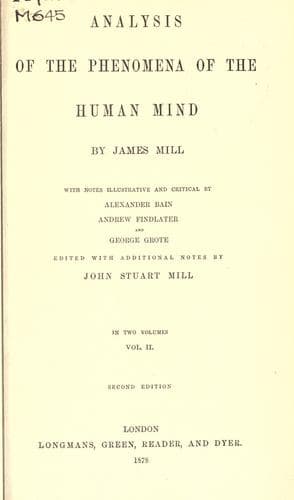
Analysis of the Phenomena of the Human MindMill, James
PhilosophyPhilosophy
Analysis of the Phenomena of the Human Mind
Mill, James
Psychology
{362} But there can be no idea of the future; because, strictly
speaking, the future is a nonentity. Of nothing there can be no
idea. It is true we can have an idea of that which never existed,
and which we do not suppose ever will exist, as of a centaur; but
this is a composition of the ideas of things which have existed. We
can conceive a sea of milk, because we have seen a sea, and milk; a
mountain of gold, because we have seen a mountain, and gold. In the
same manner we proceed with what we call the future. The ideas which
I have recently enumerated as parts of my belief of to-morrow; the
light of day, the throng in the streets, the motion of the tide at
London-bridge, are all ideas of the past. The general fact, indeed,
is not a matter of dispute. Our idea of the future, and our idea of
the past, is the same; with this difference, that it is accompanied
with retrospection in the one case, anticipation in the other. What
retrospection is, we have already examined. It is Memory. What
Anticipation is, we are now to inquire; and to that end it is
necessary to recall, distinctly, some important facts which we have
already established.
The fundamental law of association is, that when two things have
been frequently found together, we never perceive or think of the
one without thinking of the other. If the visible idea of a rose
occurs to me, the idea of its smell occurs along with it; if the
idea of the sound of a drum occurs to me, the visible idea of that
instrument occurs along with it.
Of these habitual conjunctions, there is none with which we are more
incessantly occupied, from the {363} first moment of our existence
to the last, and in which we are more deeply interested, than that
of antecedent and consequent. Of course there is none between the
ideas of which the association is more intimate and intense.
In fact, our whole lives are but a series of changes; that is, of
antecedents and consequents. The conjunction, therefore, is
incessant; and, of course, the union of the ideas perfectly
inseparable. We can no more have the idea of an event without having
the ideas of its antecedent and *its consequents, than we can have
the idea and not have it at the same time. It is utterly impossible
for me to have the visible idea of a rose, without the idea of its
having grown from the ground, which is its antecedent; it is utterly
impossible for me to have the idea of it without the ideas of its
consistence, its smell, its gravity, and so on, which are its
consequents.
Public-domain text, read in full here on John Shaqi.
Reviews
Reviews
No reviews yet
Be the first to share your thoughts on this work.
Elsewhere in the archive
Join the Discussion
Join the discussion
Sign in to leave a comment or review.
Sign InorCreate an account