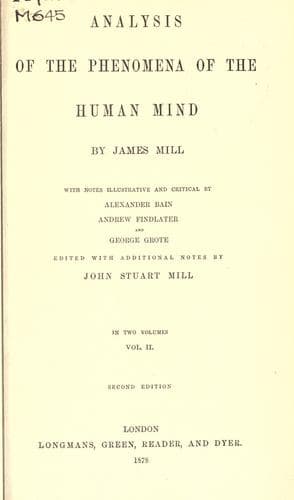
Analysis of the Phenomena of the Human MindMill, James
PhilosophyPhilosophy
Analysis of the Phenomena of the Human Mind
Mill, James
Psychology
[Bain's footnote 103: The case that is most thoroughly opposed to
the theory of indissoluble association is our belief in the
Uniformity of Nature. Our overweening tendency to anticipate the
future from the past is shown prior to all association; the first
effect of experience is to abridge and modify a strong primitive
urgency. There is, no doubt, a certain stage when association
co-operates to justify the believing state. After our headlong
instinct has, by a series of reverses, been humbled and toned down,
and after we have discovered that the uniformity, at first imposed
by the mind upon everything, applies to some things and not to
others, we are confirmed by our experience in the cases where the
uniformity prevails; and the intellectual growth of association
counts for a small part of the believing impetus. Still, the
efficacy of experience is perhaps negative rather than positive; it
saves, in certain cases, the primitive force of anticipation from
the attacks made upon it in the other cases where it is contradicted
by the facts. It does not make belief, it conserves a pre-existing
belief. (See Note at the end of the chapter.)--_B._]
This, however, is a part of our constitution, of so much importance,
that it must be scrutinized with more than ordinary minuteness.
Our first assertion was, that in every instance of belief, there is
indissoluble association of the ideas. We shall confine our
examples, for the present, to that case of belief which is more
immediately under our examination; belief in the future. I believe,
that if I put my finger in the flame of the candle, I shall feel the
pain of burning. I believe, that if a stone is dropped in the air,
it will fall to the ground. It is evident that in these cases, the
belief consists in uniting two events, the antecedent, and the
consequent. There are in it, therefore, two ideas, that of the
antecedent, and that of the consequent, and the union of those
ideas. The previous illustrations have abundantly shewn us, in what
manner the two ideas are united by association, and _indissolubly_
united. _These_ ingredients in the belief are all indisputable. That
there is any _other_ cannot be shewn.
{369} Our second assertion was, that cases of indissoluble
association, admitted by all men to be this, and nothing more, are
acknowledged as Belief. The facts (which any one may call to
recollection), in proof of this assertion, deserve the greatest
attention; they shew the mode of investigating some of the most
latent combinations of the human mind.
Public-domain text, read in full here on John Shaqi.
Reviews
Reviews
No reviews yet
Be the first to share your thoughts on this work.
Elsewhere in the archive
Join the Discussion
Join the discussion
Sign in to leave a comment or review.
Sign InorCreate an account