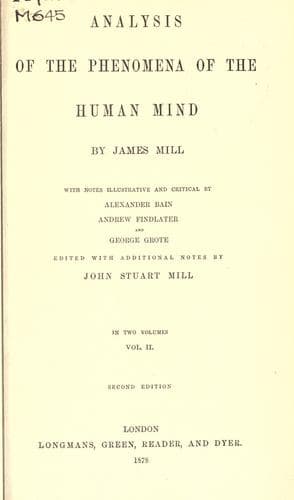
Analysis of the Phenomena of the Human MindMill, James
PhilosophyPhilosophy
Analysis of the Phenomena of the Human Mind
Mill, James
Psychology
immediately recognize, that it proceeds from another.
We must not be afraid of tediousness, while we {371} adduce
instances in superabundance, to prove that in dissoluble association
(in one remarkable class of its cases, which, on account of their
vast importance, it is found expedient to distinguish by a
particular name) is that state of consciousness, to which we have
given the name of BELIEF.
We are all of us familiar with that particular feeling, which is
produced, when we have turned ourselves round with velocity several
times. We BELIEVE that the world is turning round.
The sound of bells, opposed by the wind, appears to be farther off.
A person speaking through a trumpet appears to be nearer. Our
experience is, that sounds decrease by distance. A sound is
decreased by opposition of the wind; the idea of distance is
associated; and the association being inseparable, it is belief. A
sound is increased by issuing from a trumpet, the idea of proximity
is associated, and the association being indissoluble, it is belief.
In passing, on board of ship, another ship at sea, we believe that
she has all the motion, we none: though we may be sailing rapidly
before the wind, she making hardly any progress against it.
When we have been making a journey in a stage coach, or a voyage in
a ship, we believe, for some time after leaving the vehicle, that
still we are feeling its motion; more especially just as we are
falling asleep.
Nobody doubts, that these, and similar cases of belief, which are
very numerous, are all to be resolved into pure association. What
the associations are, we leave to be traced by the learner; so many
repetitions of the same process, though a useful exercise to him,
would be very tedious here.
{372} The Belief which takes place in Dreaming merits great
attention in this part of our inquiry. No belief is stronger than
that which we experience in dreaming. Our belief of some of the
frightful objects, which occur to us, is such, as to extort from us
loud cries; and to throw us into such tremors and bodily agitations,
as the greatest real dangers would fail in producing. Not less
intense is our belief in the pleasurable objects which occur to us
in dreams; nor are the agitations which they produce in our bodies
much less surprising. Yet there is hardly any difference of opinion
about the real nature of the phenomena which occur in dreaming. That
our dreams are mere currents of ideas, following one another by
association; not controlled, as in our waking hours, by sensations
and will; is the substance of every theory of dreaming. The belief,
therefore, which occurs in dreaming, is merely a case of
association; and hence it follows that nothing more is necessary to
account for Belief.
Public-domain text, read in full here on John Shaqi.
Reviews
Reviews
No reviews yet
Be the first to share your thoughts on this work.
Elsewhere in the archive
Join the Discussion
Join the discussion
Sign in to leave a comment or review.
Sign InorCreate an account