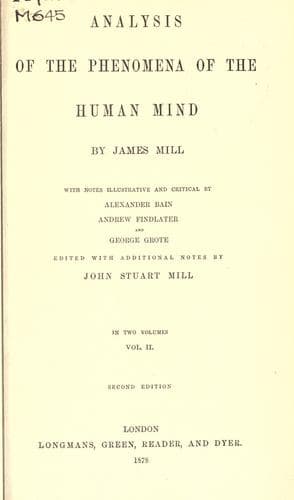
Analysis of the Phenomena of the Human MindMill, James
PhilosophyPhilosophy
Analysis of the Phenomena of the Human Mind
Mill, James
Psychology
We have already shewn, under the head NAMING, when explaining the
purpose to which Predication is subservient, that all Predication
may be strictly considered as of one kind, the application to the
same thing of another name of greater extent; in other words, that
Predication by what Logicians call the Difference, Property, or
Accident of a thing, may be reduced to Predication by the Genus or
Species; but as there is a seeming difference in these latter cases,
a short illustration of them will probably be useful.
Thus, suppose I say, "Man is rational," and that I choose to expound
it, without the aid of the word animal, understood; what is there in
the case? The word "man," marks a certain cluster of ideas.
"Rational" marks a portion of that cluster. In the {391} cluster
marked "man," the cluster marked "rational" is included. To
recognise this, is also called believing the proposition. But to
have one cluster of ideas, and know what it is; then another, and
know what it is, is merely to have the two clusters. To have a
second cluster, part of a first, and to know that it is a part of
the first, is the same thing.
The peculiar property of that class of words to which "Rational"
belongs, must here be recollected. They are the _connotative_ class.
Beside marking some thing peculiarly, they mark something else in
conjunction; and this last, they are said to _connote_. Thus the
word "rational," beside the part of the cluster, man, which it
peculiarly marks, connotes, or marks in conjunction with it, the
part included under the word animal
It will be easy to apply the same explanation to all other cases.
I say, the rose is red. Red is a connotative term, distinctively
marking the idea of red. The idea of red is part of the cluster
I mark by the word rose.
Take a more obscure expression; Fire burns. It is very obvious, that
in the cluster of ideas I mark by the word fire, the idea of burning
is included. To have the idea, "fire," therefore, and the idea
"burning," called up by the names standing in predication, is to
believe the proposition.
The Predications, "Virtue is lovely," "Vice is hateful," and the
like, all admit of a similar exposition. In the cluster "virtue,"
the idea of loveliness is included; in the cluster "vice," that of
hatefulness is included. Such propositions, therefore, merely say,
that what is a part of a thing, is a part of it. The {392} two words
call up the two ideas; and to have two ideas, one a part of another,
and know that one is part of another, is not two things, but one and
the same thing. To have the idea of rose, and the idea of red, and
to know that red makes part of rose, is not two things, but one and
the same thing.
Public-domain text, read in full here on John Shaqi.
Reviews
Reviews
No reviews yet
Be the first to share your thoughts on this work.
Elsewhere in the archive
Join the Discussion
Join the discussion
Sign in to leave a comment or review.
Sign InorCreate an account