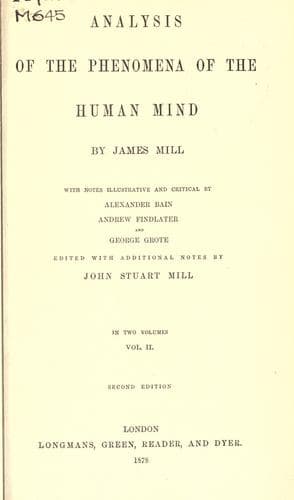
Analysis of the Phenomena of the Human MindMill, James
PhilosophyPhilosophy
Analysis of the Phenomena of the Human Mind
Mill, James
Psychology
With respect to the SENSATIONS, it is obvious enough that they
occur, according to the order established among what we call the
objects of nature, whatever those objects are; to ascertain more and
more of which order is the business of physical philosophy in all
its branches.
Of the order established among the objects of nature, by which we
mean the objects of our senses, two remarkable cases are all which
here we are called upon to notice; the SYNCHRONOUS ORDER, and the
SUCCESSIVE ORDER. The synchronous order, or order of simultaneous
existence, is the order in space; the successive order, or order of
antecedent and consequent existence, is the order in time. Thus the
various objects in my room, the chairs, the tables, the books, have
the synchronous order, or order in space. The falling of the spark,
and the explosion of the gunpowder, have the successive order, or
order in time.
According to this order, in the objects of sense, there is a
synchronous, and a successive, order of our sensations. I have
SYNCHRONICALLY, or at the same instant, the sight of a great variety
of objects; touch of all the objects with which my body is in
contact; hearing of all the sounds which are reaching my ears;
smelling of all the smells which are reaching my {72} nostrils; taste
of the apple which I am eating; the sensation of resistance both
from the apple which is in my mouth, and the ground on which I
stand; with the sensation of motion from the act of walking. I have
SUCCESSIVELY the sight of the flash from the mortar fired at a
distance, the hearing of the report, the sight of the bomb, and of
its motion in the air, the sight of its fall, the sight and hearing
of its explosion, and lastly, the sight of all the effects of that
explosion.[25]
[Bain's footnote 25: There is here raised the interesting and
important question, how far are we able to entertain synchronous
sensations; in other words, whether or not we can be cognisant of a
plurality of sensations at the same instant of time. There are
various circumstances tending to obscure this point; the chief being
the extreme rapidity of our mental transitions.
It is requisite to view the question from two sides, the side of
sensation and the side of action. On the first, the appearances are
more in favour of plurality; on the second, more in favour of unity.
Public-domain text, read in full here on John Shaqi.
Reviews
Reviews
No reviews yet
Be the first to share your thoughts on this work.
Elsewhere in the archive
Join the Discussion
Join the discussion
Sign in to leave a comment or review.
Sign InorCreate an account