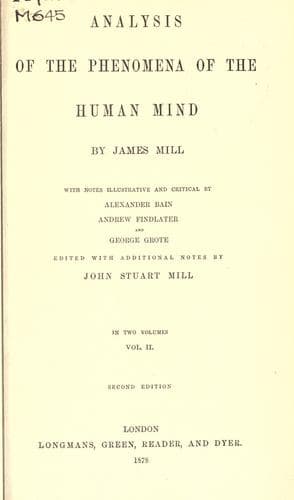
Analysis of the Phenomena of the Human MindMill, James
PhilosophyPhilosophy
Analysis of the Phenomena of the Human Mind
Mill, James
Psychology
Next as to the sense of Hearing. Peculiar difficulties attend the
explanation of this sense. There is only one main line of access to
the inner ear, where the nerves are distributed, namely, the solid
chain of bones of the middle ear; and that line can hardly be
supposed capable of conveying at the same instant a plurality of
different series of vibrations. Yet we fancy that we hear a
concurring plurality of sounds. Of what avail would be a band of a
hundred performers if there were no power of taking in simultaneous
pulses of sound? There is, however, an absence of accurate
investigation of this point; no one has endeavoured to ascertain how
much of the complex effect is due to the rapid transitions of the
ear from one sound to another, how much to the concurrence of
several series of pulses in one augmented series, and how much to
the composition of successive effects in the ear into a synchronous
whole in the emotional wave, or general excitement of the brain. It
will be found, by any careful observer, that in listening to a band,
we are really occupied with very few of the sounds at the same
instant of time; we perform a number of rapid movements of the
attention from one to another; while, at each moment, we are under
an influence remaining from the recently occurring beats, to which
we are not now giving our full attention.
Touch is exactly parallel to Sight, and need not be dwelt upon. In
Smell, and in Taste, we may have a plurality of distinguishable
effects at one moment: we often experience complex odours and
tastes. The above remarks will apply to these. The undoubted
tendency of the mind is to single out, for attention, the separate
constituents by turns, and to pass with rapidity from one to
another; while it is also true that the individual effects that are
for the moment seemingly neglected, still exercise an influence on
the consciousness; which would be decisively shown (as in the case
of sight) on any occasion of their suddenly increasing in force, or
suddenly vanishing. Also, in their state of having fallen out of
attention, they still leave an influence to modify the present
sensation, the effect of their being attended to in the previous
instant. Until we can measure the rapidity of those transitions of
the attention, we are not in a position to affirm absolutely the
power of double, triple, or multiple attention, although to all
practical intents such a power is possessed.
Public-domain text, read in full here on John Shaqi.
Reviews
Reviews
No reviews yet
Be the first to share your thoughts on this work.
Elsewhere in the archive
Join the Discussion
Join the discussion
Sign in to leave a comment or review.
Sign InorCreate an account