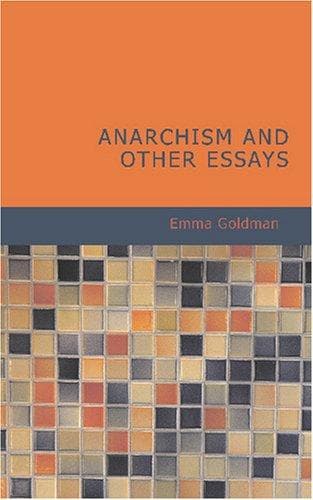
Anarchism; Feminism; Women -- Social and moral questions
In America it is just the reverse. Republicanism stands for vested
rights, for imperialism, for graft, for the annihilation of every
semblance of liberty. Its ideal is the oily, creepy respectability
of a McKinley, and the brutal arrogance of a Roosevelt.
The Spanish republican rebels were subdued. It takes more than one
brave effort to split the rock of ages, to cut off the head of that
hydra monster, the Catholic Church and the Spanish throne. Arrest,
persecution, and punishment followed the heroic attempt of the little
band. Those who could escape the bloodhounds had to flee for safety
to foreign shores. Francisco Ferrer was among the latter. He went
to France.
How his soul must have expanded in the new land! France, the cradle
of liberty, of ideas, of action. Paris, the ever young, intense
Paris, with her pulsating life, after the gloom of his own belated
country,--how she must have inspired him. What opportunities, what a
glorious chance for a young idealist.
Francisco Ferrer lost no time. Like one famished he threw himself
into the various liberal movements, met all kinds of people, learned,
absorbed, and grew. While there, he also saw in operation the Modern
School, which was to play such an important and fatal part in his
life.
The Modern School in France was founded long before Ferrer's time.
Its originator, though on a small scale, was that sweet spirit,
Louise Michel. Whether consciously or unconsciously, our own great
Louise felt long ago that the future belongs to the young generation;
that unless the young be rescued from that mind and soul destroying
institution, the bourgeois school, social evils will continue to
exist. Perhaps she thought, with Ibsen, that the atmosphere is
saturated with ghosts, that the adult man and woman have so many
superstitions to overcome. No sooner do they outgrow the deathlike
grip of one spook, lo! they find themselves in the thralldom of
ninety-nine other spooks. Thus but a few reach the mountain peak of
complete regeneration.
The child, however, has no traditions to overcome. Its mind is not
burdened with set ideas, its heart has not grown cold with class and
caste distinctions. The child is to the teacher what clay is to the
sculptor. Whether the world will receive a work of art or a wretched
imitation, depends to a large extent on the creative power of the
teacher.
Louise Michel was pre-eminently qualified to meet the child's soul
cravings. Was she not herself of a childlike nature, so sweet and
tender, unsophisticated and generous. The soul of Louise burned
always at white heat over every social injustice. She was invariably
in the front ranks whenever the people of Paris rebelled against some
wrong. And as she was made to suffer imprisonment for her great
devotion to the oppressed, the little school on Montmartre was soon
no more. But the seed was planted, and has since borne fruit in many
cities of France.
Public-domain text, read in full here on John Shaqi.
Reviews
Reviews
No reviews yet
Be the first to share your thoughts on this work.
Elsewhere in the archive
Join the Discussion
Join the discussion
Sign in to leave a comment or review.
Sign InorCreate an account