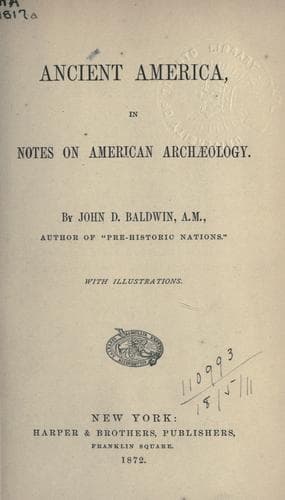
Ancient America, in Notes on American ArchaeologyBaldwin, John D. (John Denison)
History
Ancient America, in Notes on American Archaeology
Baldwin, John D. (John Denison)
America -- Antiquities; America -- Discovery and exploration -- Pre-Columbian; Indians -- Antiquities
These Aztecs were manifestly something very different from “Mexican
savages.” At the same time, they were less advanced in many things than
their predecessors. Their skill in architecture and architectural
ornamentation did not enable them to build such cities as Mitla and
Palenque, and their “picture writing” was a much ruder form of the
graphic art than the phonetic system of the Mayas and Quichés. It does
not appear that they ever went so far in literary improvement as to
adopt this simpler and more complete system for any purpose whatever. If
the country had never, in the previous ages, felt the influence of a
higher culture than that of the Aztecs, it would not have now, and never
could have had, ruined cities like Mitla, Copan, and Palenque. Not only
was the system of writing shown by the countless inscriptions quite
beyond the attainments of Aztec art, but also the abundant sculptures
and the whole system of decoration found in the old ruins.
X.
ANCIENT PERU.
The ruins of Ancient Peru are found chiefly on the elevated table-lands
of the Andes, between Quito and Lake Titicaca; but they can be traced
five hundred miles farther south, to Chili, and throughout the region
connecting these high plateaus with the Pacific coast. The great
district to which they belong extends north and south about two thousand
miles. When the marauding Spaniards arrived in the country, this whole
region was the seat of a populous and prosperous empire, complete in its
civil organization, supported by an efficient system of industry, and
presenting a very notable development of some of the more important arts
of civilized life. These ruins differ from those in Mexico and Central
America. No inscriptions are found in Peru; there is no longer a
“marvelous abundance of decorations;” nothing is seen like the monoliths
of Copan or the bas-reliefs of Palenque. The method of building is
different; the Peruvian temples were not high truncated pyramids, and
the great edifices were not erected on pyramidal foundations. The
Peruvian ruins show us remains of cities, temples, palaces, other
edifices of various kinds, fortresses, aqueducts (one of them four
hundred and fifty miles long), great roads (extending through the whole
length of the empire), and terraces on the sides of mountains. For all
these constructions the builders used cut stone laid in mortar or
cement, and their work was done admirably, but it is every where seen
that the masonry, although sometimes ornamented, was generally plain in
style and always massive. The antiquities in this region have not been
as much explored and described as those north of the isthmus, but their
general character is known, and particular descriptions of some of them
have been published.
THE SPANISH HUNT FOR PERU.
Public-domain text, read in full here on John Shaqi.
Reviews
Reviews
No reviews yet
Be the first to share your thoughts on this work.
Elsewhere in the archive
Join the Discussion
Join the discussion
Sign in to leave a comment or review.
Sign InorCreate an account