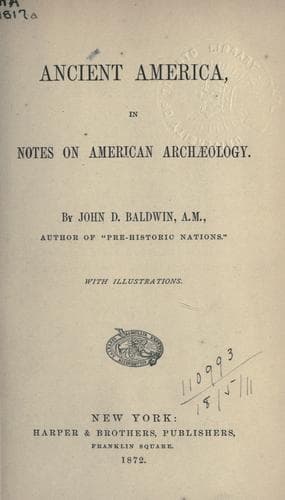
Ancient America, in Notes on American ArchaeologyBaldwin, John D. (John Denison)
History
Ancient America, in Notes on American Archaeology
Baldwin, John D. (John Denison)
America -- Antiquities; America -- Discovery and exploration -- Pre-Columbian; Indians -- Antiquities
Pizarro went down the coast, landing from time to time to explore and
rob villages, until he reached about the fourth degree of north
latitude, when he was obliged to return for supplies and repairs. It
became necessary to reconstruct the contract and allow Pedrarias an
interest in it. On the next voyage, one of the vessels went half a
degree south of the equator, and encountered a vessel “like a European
caravel,” which was, in fact, a Peruvian _balsa_, loaded with
merchandise, vases, mirrors of burnished silver, and curious fabrics of
cotton and woolen.
It became again indispensable to send back to Panama for supplies and
repairs, and Pizarro was doomed to wait for them seven months on an
island. He next visited Tumbez, in Peru, and went to the ninth degree of
south latitude; but he was obliged to visit Spain to get necessary aid
before he could attempt any thing more, and it was not until the year
1531 that the conquest of Peru was actually undertaken.
In 1531 Pizarro finally entered Tumbez with his buccaneers, and marched
into the country, sending word to the Inca that he came to aid him
against his enemies. There had been a civil war in the country, which
had been divided by the great Inca, Huayna Capac, the conqueror of
Quito, between his two sons, Huascar and Atahuallpa, and Huascar had
been defeated and thrown into prison, and finally put to death. At a
city called Caxamalca, Pizarro contrived, by means of the most atrocious
treachery, to seize the Inca and massacre some ten thousand of the
principal Peruvians, who came to his camp unarmed on a friendly visit.
This threw the whole empire into confusion, and made the conquest easy.
The Inca filled a room with gold as the price of his ransom; the
Spaniards took the gold, broke their promise, and put him to death.
THE RUINS NEAR LAKE TITICACA.
Public-domain text, read in full here on John Shaqi.
Reviews
Reviews
No reviews yet
Be the first to share your thoughts on this work.
Elsewhere in the archive
Join the Discussion
Join the discussion
Sign in to leave a comment or review.
Sign InorCreate an account