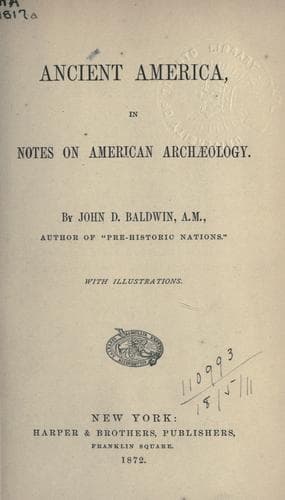
Ancient America, in Notes on American ArchaeologyBaldwin, John D. (John Denison)
History
Ancient America, in Notes on American Archaeology
Baldwin, John D. (John Denison)
America -- Antiquities; America -- Discovery and exploration -- Pre-Columbian; Indians -- Antiquities
Manco-Capac, here set down as the first Inca, with a marvelous story of
his mysterious origin and his miraculous powers as a civilizer, was
undoubtedly borrowed from traditions of the origin of civilization in
the more ancient times, which had been used by the Incas in support of
their claim to direct descent from the sun. In reality, the first Inca
was Rocca, or Sinchi-Rocca, and several of the early Spanish writers
were sufficiently well informed to see this. The period of the Incas
must have been less than five hundred years if their dynasty consisted
of no more than twelve or thirteen sovereigns. In other respects, this
table of the sovereigns may be substantially correct, for there is a
general agreement in regard to the names and the order of succession,
although Montesinos maintains that the fifth Inca on the list was
borrowed by Garcilasso from traditions of a much more ancient sovereign
who was greatly celebrated in the historical poems, or confounded with
him. The period of the Incas was very distinct in Peruvian history, but
it is now understood that they represent only the last period in the
history of a civilization which began much farther back in the past.
FERNANDO MONTESINOS.
The only Spanish writer who really studied the ancient history of Peru
in the traditional and other records of the country was Fernando
Montesinos, who went there about a century after the Conquest. He was
sent from Spain on service which took him to every part of Peru, and
gave him the best possible opportunities for investigation. He was a
scholar and a worker, with a strong inclination to such studies, and,
during two periods of residence in the country, he devoted fifteen years
to these inquiries with unremitting industry and great success. He soon
learned to communicate freely with the Peruvians in their own language;
then he applied himself to collect the historical poems, narratives, and
traditions. He succeeded in getting assistance from many of the older
men who had learned of the _amautas_, and especially of those who were
trained to read the _quippus_. Nothing was omitted which could aid his
purpose. In this way Montesinos made a great collection of what may be
called the _old Peruvian documents_, and gained a vast amount of
information which no other writer had used or even sought to acquire.
Public-domain text, read in full here on John Shaqi.
Reviews
Reviews
No reviews yet
Be the first to share your thoughts on this work.
Elsewhere in the archive
Join the Discussion
Join the discussion
Sign in to leave a comment or review.
Sign InorCreate an account