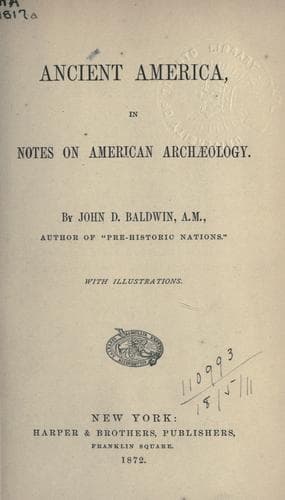
Ancient America, in Notes on American ArchaeologyBaldwin, John D. (John Denison)
History
Ancient America, in Notes on American Archaeology
Baldwin, John D. (John Denison)
America -- Antiquities; America -- Discovery and exploration -- Pre-Columbian; Indians -- Antiquities
Peru would now be a very different country if the Spaniards had been
sufficiently controlled by Christianity and civilization to treat the
Peruvians justly, and seek nothing more than friendly intercourse with
them. But they went there as greedy buccaneers, unscrupulous robbers,
and brought every thing to ruin. At no time since the Spanish Conquest
has the country been as orderly, as prosperous, or as populous as they
found it. It has fallen to a much lower condition. Industry and thrift
have been supplanted by laziness and beggarly poverty. Ignorance and
incapacity have taken the place of that intelligence and enterprise
which enabled the old Peruvians to maintain their remarkable system of
agriculture, complete their great works, and made them so industrious
and skillful in their manufactures. The region covered by the Peruvian
empire has not half as many people now as it had in the time of the
Incas. Is it possible to imagine the present inhabitants of Ecuador,
Peru, and Bolivia cultivating their soil with intelligent industry,
building aqueducts five hundred miles long, and constructing
magnificently paved roads through the rocks and across the ravines of
the Andes, from Quito to Chili? One of the scholars connected with the
scientific expedition which visited South America in 1867, describing
the ancient greatness and present inferior condition of Quito, exclaims,
“May the future bring it days equal to those when it was called the
‘City of the Incas!’” He might appropriately utter a similar wish for
the whole country.
APPENDIX.
APPENDIX.
A.
THE NORTHMEN IN AMERICA.
It is generally known, I suppose, that original manuscript records of
Norse voyages to this continent have been carefully preserved in
Iceland, and that they were first published at Copenhagen in 1837, with
a Danish and a Latin translation. These narratives are plain,
straightforward, business-like accounts of actual voyages made by the
Northmen, in the tenth and eleventh centuries, to Greenland,
Newfoundland, Nova Scotia, and the coast of Massachusetts and Rhode
Island. Within the whole range of the literature of discovery and
adventure no volumes can be found which have more abundant internal
evidence of authenticity. It always happens, when something important is
unexpectedly added to our knowledge of the past, that somebody will
blindly disbelieve. Dugald Stewart could see nothing but “frauds of
arch-forgers” in what was added to our knowledge of ancient India when
the Sanskrit language and literature were discovered. In the same way,
here and there a doubter has hesitated to accept the fact communicated
by these Norse records; but, with the evidence before us, we may as
reasonably doubt any unquestioned fact of history which depends on
similar testimony.
Public-domain text, read in full here on John Shaqi.
Reviews
Reviews
No reviews yet
Be the first to share your thoughts on this work.
Elsewhere in the archive
Join the Discussion
Join the discussion
Sign in to leave a comment or review.
Sign InorCreate an account