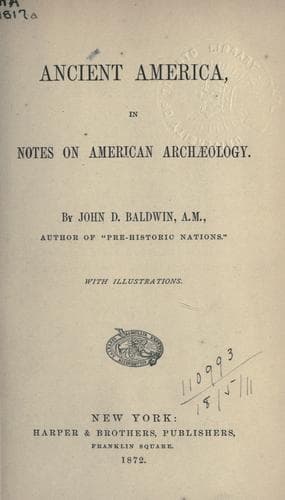
Ancient America, in Notes on American ArchaeologyBaldwin, John D. (John Denison)
History
Ancient America, in Notes on American Archaeology
Baldwin, John D. (John Denison)
America -- Antiquities; America -- Discovery and exploration -- Pre-Columbian; Indians -- Antiquities
Thus it appears to be an authenticated fact that the Northmen had a
settlement or settlements in New England six hundred years previous to
the arrival of English settlers. It is probable that their Vinland
settlements consisted chiefly of trading and lumbering establishments.
The first explorers “loaded their vessels with timber” when ready to
return to Greenland, where the lack of timber was so great that the
settlers found it necessary to use stone for building material. The
Vinland timber-trade became naturally an important business, but neither
Greenland nor Iceland could furnish emigrants to occupy the country.
Traces of the old Norse settlements in Greenland are still visible in
the ruins of stone buildings. Near the Bay of Igalito, in Greenland, are
remains of a stone church. Vinland was covered with great forests, and
there it was much easier and cheaper to build houses of wood.
The Norse records speak also of a region south of Vinland to which
voyages were made. It is called Huitramannaland. Indeed, two great
regions farther south are mentioned. There is a romantic story of one
Biorn Asbrandson, a noble Icelander, who, being crossed in his
matrimonial desires, went away toward Vinland; but his vessel was driven
much farther south by a storm. Nothing was heard of him until part of
the crew of a Norse vessel, on a voyage to Huitramannaland, were
captured by the natives, among whom Biorn was living as a chief. He
discovered an old acquaintance among the prisoners whom he found means
to release. He talked freely with his old friend of the past, and of
Iceland, but would not leave his savage friends.
How little we know of what has been in the past ages, notwithstanding
our many volumes of history! We listen attentively to what gets a wide
and brilliant publication, and either fail to hear or doubt every thing
else. If these Norse adventurers had sailed from England or Spain, those
countries being what they were in the time of Columbus, their colonies
would not have failed, through lack of men and means to support and
extend them, and the story of their discoveries would have been told in
every language and community of the civilized world. But the little
communities in Iceland and Greenland were very different from rich and
powerful nations. Instead of being in direct communication with the
great movements of human life in Europe, recorded in what we read as
history, they were far off in the Northern Ocean, and, out of Norway,
almost unknown to Europe. Afterward, when the name and discoveries of
Columbus had taken control of thought and imagination, it became
difficult for even intelligent men, with the old Norse records before
them, to see the claims of the Northmen.
B.
THE WELSH IN AMERICA.
The story of the emigration to America of Prince Madoc, or Madog, is
told in the old Welsh books as follows:
Public-domain text, read in full here on John Shaqi.
Reviews
Reviews
No reviews yet
Be the first to share your thoughts on this work.
Elsewhere in the archive
Join the Discussion
Join the discussion
Sign in to leave a comment or review.
Sign InorCreate an account