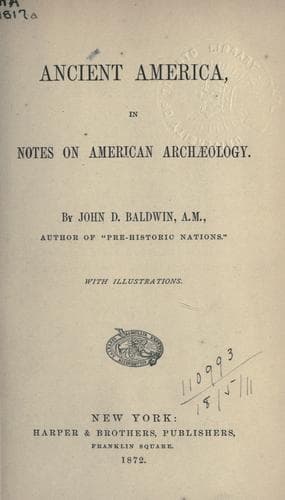
Ancient America, in Notes on American ArchaeologyBaldwin, John D. (John Denison)
History
Ancient America, in Notes on American Archaeology
Baldwin, John D. (John Denison)
America -- Antiquities; America -- Discovery and exploration -- Pre-Columbian; Indians -- Antiquities
According to this truly monkish theory, the “lost ten tribes of Israel”
left Palestine, Syria, Assyria, or whatever country they dwelt in at the
time, traversed the whole extent of Asia, crossed over into America at
Behring’s Strait, went down the Pacific coast, and established a
wonderful civilization in that part of the continent where the great
ruins are found. The kingdom of the ten tribes was destroyed not long
previous to the year 700 B.C. How many years are allowed, after their
escape from captivity, for this unparalleled journey, has not yet been
ascertained. But, if such a journey had been possible, it would have
resulted in utter barbarism rather than any notable phase of civilized
life. Even the Jews who remained faithful to Moses, although important
on account of their scriptures and their religion, were not remarkable
for civilization. They were incapable of building their own Temple
without aid from the Tyrians. Moreover, there is not any where either a
fact, a suggestion, or a circumstance of any kind to show that the “lost
ten tribes” ever left the countries of Southwestern Asia, where they
dwelt after the destruction of their kingdom. They were “lost” to the
Jewish nation because they rebelled, apostatized, and, after their
subjugation by the Assyrians in 721 B.C., were to a great extent
absorbed by other peoples in that part of Asia. Some of them probably
were still in Palestine when Christ appeared. This wild notion, called a
theory, scarcely deserves so much attention. It is a lunatic fancy,
possible only to men of a certain class, which in our time does not
multiply.
THE “MALAY” THEORY.
Public-domain text, read in full here on John Shaqi.
Reviews
Reviews
No reviews yet
Be the first to share your thoughts on this work.
Elsewhere in the archive
Join the Discussion
Join the discussion
Sign in to leave a comment or review.
Sign InorCreate an account