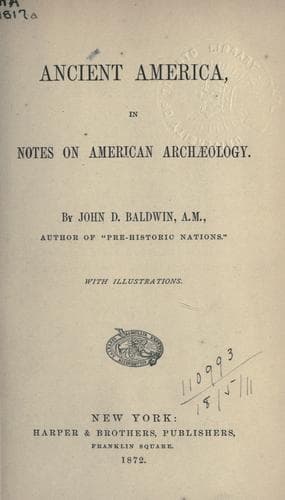
Ancient America, in Notes on American ArchaeologyBaldwin, John D. (John Denison)
History
Ancient America, in Notes on American Archaeology
Baldwin, John D. (John Denison)
America -- Antiquities; America -- Discovery and exploration -- Pre-Columbian; Indians -- Antiquities
The people known to us as Phœnicians were pre-eminent as the colonizing
navigators of antiquity. They were an enlightened and enterprising
maritime people, whose commerce traversed every known sea, and extended
its operations beyond the “Pillars of Hercules” into the “great exterior
ocean.” The early Greeks called them Ethiopians (not meaning either
black men or Africans), and said they went every where, establishing
their colonies and their commerce in all the coast regions, “from the
extreme east to the extreme west.” But the great ages of this people are
in the distant past, far beyond the beginning of what we call history.
History has knowledge only of a few of their later communities, the
Sabeans of Southern Arabia, the Phœnicians (meaning chiefly the
Tyrians), and the Carthaginians. What a change there would be in the
prevalent conceptions of the past if we could have a complete record of
this race from the beginning of its development!
It is not difficult to believe that communities of the Phœnician or
Ethiopian race were established all around the Mediterranean, and even
beyond the Strait of Gibraltar, in ages quite as old as Egypt or
Chaldea, and that they had communication with America before Tyre or
Sidon was built. Why did the ancients say so much of a “great Saturnian
continent” beyond the Atlantic if nobody in the pre-historic ages had
ever seen that continent? It was there, as they said and as we know; but
whence came their knowledge of it, and such knowledge as led them to
describe it as “larger than Asia (meaning Asia Minor), Europe, and Libya
together?” This ancient belief must have been due to Phœnician or
Ethiopian communication with America in earlier times, which was
imperfectly recollected, or perhaps never completely revealed to other
nations; and this must have taken place at a very remote period, for
imperfect recollection of the great continent across the Atlantic,
including what Solon heard in Egypt of Atlantis, was more ancient than
the constrained voyage of that Tyrian ship of which Diodorus Siculus
gives an account; and it can be seen that the early Greeks had a better
knowledge even of Western Europe than those of later times. A dark age,
so far as relates to geographical knowledge, set in upon the countries
around the Ægean Sea and on the coast of Asia Minor after the
independence and enterprise of Tyre and the other Phœnician cities were
destroyed by the Assyrians, toward the close of the ninth century before
Christ, which was disturbed some four hundred and fifty or five hundred
years later by the conquests of Alexander the Great.
Public-domain text, read in full here on John Shaqi.
Reviews
Reviews
No reviews yet
Be the first to share your thoughts on this work.
Elsewhere in the archive
Join the Discussion
Join the discussion
Sign in to leave a comment or review.
Sign InorCreate an account