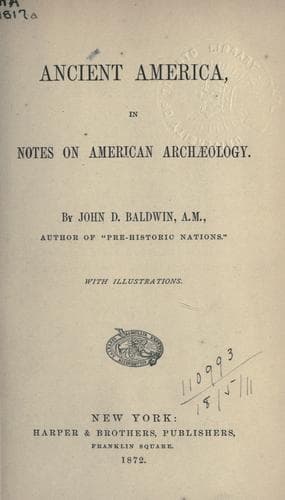
Ancient America, in Notes on American ArchaeologyBaldwin, John D. (John Denison)
History
Ancient America, in Notes on American Archaeology
Baldwin, John D. (John Denison)
America -- Antiquities; America -- Discovery and exploration -- Pre-Columbian; Indians -- Antiquities
I have already stated in general terms the hypothesis advanced by
Brasseur de Bourbourg and some other writers. This may be called the
“Atlantic” theory, for it attributes the civilization of Ancient America
to the Atlantides or Atlantic race, who occupied the lost “island of
Atlantis.” Brasseur de Bourbourg has studied the monuments, writings,
and traditions left by this civilization more carefully and thoroughly
than any other man living. He has fancies which may be safely rejected,
and he has theories which, doubtless, will always lack confirmation; but
he has much, also, which demands respectful consideration. There is a
great deal in his books to provoke criticism; those well acquainted with
the antiquities and ancient speech of Egypt may reasonably give way to
a smile of incredulity while reading what he says in support of the
notion that the great civilization of Egypt also came originally from
this Atlantic race. Nevertheless, his volumes are important, because
they furnish materials which others can use more carefully, and because
he has learned to decipher some of the Central American writings and
brought to view certain paths of inquiry which others may pursue with a
more rigid method.
As already stated, his Atlantic theory of the old American civilization
is, that it was originated on this continent, but on a portion of the
continent which is now below the waters of the Atlantic Ocean. It
supposes the continent extended, anciently, from New Granada, Central
America, and Mexico in a long, irregular peninsula, so far across the
Atlantic that the Canary, Madeira, and Azores or Western Islands may be
remains of this portion of it. High mountains stood where we now find
the West India islands. Beyond these, toward Africa and Europe, was a
great extent of fertile and beautiful land, and here arose the first
civilization of mankind, which flourished many ages, until at length
this extended portion of the continent was ingulfed by a tremendous
convulsion of nature, or by a succession of such convulsions which made
the ruin complete. After the cataclysm, a part of the Atlantic people
who escaped destruction settled in Central America, where perhaps their
civilization had been previously introduced. The reasons urged in
support of this hypothesis make it seem plausible, if not probable, to
imaginative minds.
Public-domain text, read in full here on John Shaqi.
Reviews
Reviews
No reviews yet
Be the first to share your thoughts on this work.
Elsewhere in the archive
Join the Discussion
Join the discussion
Sign in to leave a comment or review.
Sign InorCreate an account