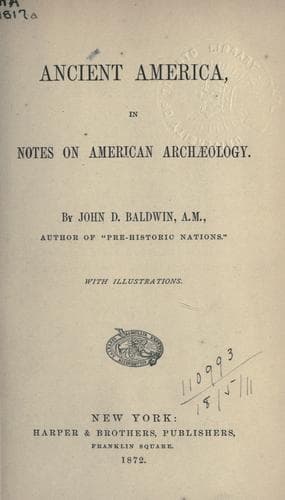
Ancient America, in Notes on American ArchaeologyBaldwin, John D. (John Denison)
History
Ancient America, in Notes on American Archaeology
Baldwin, John D. (John Denison)
America -- Antiquities; America -- Discovery and exploration -- Pre-Columbian; Indians -- Antiquities
“There are those who, in examining the map of America, do not confine
themselves to thinking with the French Pliny that the innumerable
islands situated from the mouth of the Orinoco to the Bahama Channel
(islands which include several _Grenadins_ not always visible in very
high tides or great agitations of the sea) should be considered as
summits of vast mountains whose bases and sides are covered with water,
but who go farther, and suppose these islands to be the tops of the most
elevated of a chain of mountains which crowned a portion of the
continent whose submersion has produced the Gulf of Mexico. But to
sustain this opinion it must be added that another vast surface of land
which united the islands of this archipelago to the continent, from
Yucatan to the mouth of the Orinoco, was submerged in the same way, and
also a third surface which connected them with the peninsula of Florida
and with whatever land may have constituted the northern termination;
for we can not imagine that these mountains whose summits appear above
water stood on the terminating line of the continent.”
He quotes, also, another authority which “can not be suspected,” namely,
M. Charles Martins, who said, in the _Revue des Deux Mondes_ for March
1, 1867, “Now, hydrography, geology, and botany agree in teaching us
that the Azores, the Canaries, and Madeira are the remains of a great
continent which formerly united Europe to North America.” He could have
added other quotations in the same strain. Those geologists who believe
that “our continents have long remained in nearly the same relative
position” would probably give the supposed change a much greater
antiquity than Brasseur de Bourbourg would be likely to accept; and the
geological “Uniformitarians” would deny with emphasis that so great a
change in the shape of a continent was ever effected by such means, or
with such rapidity as he supposes. But the latest and most advanced
school of geological speculation does not exclude “Catastrophism,” and,
therefore, will not deny the possibility of sudden and great changes by
this method.
Public-domain text, read in full here on John Shaqi.
Reviews
Reviews
No reviews yet
Be the first to share your thoughts on this work.
Elsewhere in the archive
Join the Discussion
Join the discussion
Sign in to leave a comment or review.
Sign InorCreate an account