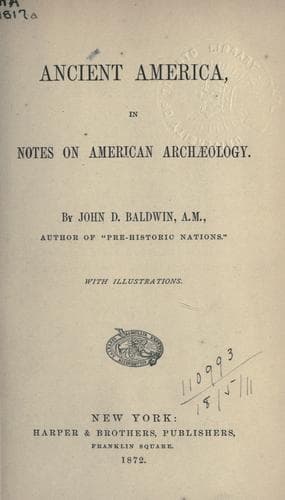
Ancient America, in Notes on American ArchaeologyBaldwin, John D. (John Denison)
History
Ancient America, in Notes on American Archaeology
Baldwin, John D. (John Denison)
America -- Antiquities; America -- Discovery and exploration -- Pre-Columbian; Indians -- Antiquities
If, as there is reason to believe, the countries on the Mediterranean
had communication with America in very ancient times, they found here a
civilization already developed, and contributed nothing to change its
style of building and decorating cities. They may have influenced it in
other respects; for, if such communication was opened across the
Atlantic, it was probably continued for a long time, and its
interruption may or may not be due, as Brasseur de Bourbourg supposes,
to the cataclysm which ingulfed Atlantis. Religious symbols are found
in the American ruins which remind us of those of the Phœnicians, such
as figures of the serpent, which appear constantly, and the cross,
supposed by some to represent the mounting of the magnetic needle,
which was among the emblems peculiar to the goddess Astarte. A figure
appears occasionally in the sculptures, in which some have sought to
recognize Astarte, one at Palenque being described as follows: “It is a
female figure moulded in stucco, holding a child on her left arm and
hand, just as Astarte appears on the Sidonian medals.” I find it
impossible to see that this figure has any resemblance whatever to the
Phœnician goddess. They are not alike either in dress, posture, or
expression. Dupaix describes it correctly in saying it represents a
person apparently “absorbed in devotion”--a worshiper, and not a
goddess. Moreover, Astarte usually appears on the medals standing on
the forward deck of a vessel, holding a cross with one hand, and
pointing forward with the other. And, finally, this figure seems to
represent, not a woman, but a priest. There was sun-worship in America,
and the phallic ceremonies existed in some places in the time of
Cortez. In Asia these ceremonies and figures of the serpent were
usually associated with sun-worship. Humboldt was sure that these
symbols came to America from the Old World. A more careful study of the
subject might have led him to modify this belief. But, whether we adopt
his explanation or some other, the traditions on both sides of the
Atlantic are without meaning unless it be admitted that there was
communication between the two continents in times of which we have no
history.
FOOTNOTES:
[170-*] See Appendix C.
VIII.
AMERICAN ANCIENT HISTORY.
Public-domain text, read in full here on John Shaqi.
Reviews
Reviews
No reviews yet
Be the first to share your thoughts on this work.
Elsewhere in the archive
Join the Discussion
Join the discussion
Sign in to leave a comment or review.
Sign InorCreate an account