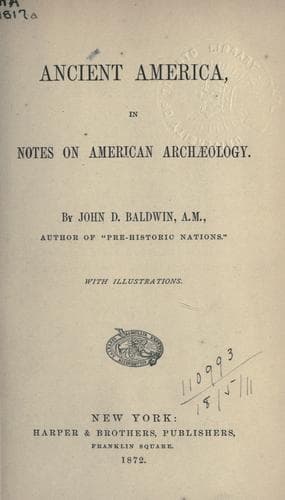
Ancient America, in Notes on American ArchaeologyBaldwin, John D. (John Denison)
History
Ancient America, in Notes on American Archaeology
Baldwin, John D. (John Denison)
America -- Antiquities; America -- Discovery and exploration -- Pre-Columbian; Indians -- Antiquities
As already stated, none of the great books of annals have been
discovered, but some of the old American manuscripts now preserved in
several of the libraries and private collections of Europe are
important. Three are specified as particularly valuable to students of
American antiquity: that called the “Codex Chimalpopoca,” an old Toltec
book, written in the Toltec language; one now entitled the “Codex
Cakchiquel;” and the “Popol-Vuh.” The latter, written in the Quiché
dialect, was translated into Spanish two hundred years ago by Ximenes,
but his translation remained in Guatemala unprinted and quite unknown
until it was discovered in our time. Brasseur de Bourbourg, who is
master of the Quiché language, and to whom we are indebted for most that
is known of the manuscripts of Ximenes, thought this Spanish translation
very imperfect; therefore he has translated the work into French.
The “Popol-Vuh” was written in 1558 as an abridged reproduction of a
very ancient Quiché book which contained an account of the history,
traditions, religion, and cosmogony of the Quichés. The first part of it
is devoted to the cosmogony and traditional lore; the rest gives an
account of the Quichés, who, at the time of the Conquest, were the
dominant people in the Central American regions south of the great
forest. If the history were consecutive and clear, it would not take us
back into the past more than three or four centuries beyond 1558, for
the Quiché domination was probably not much older than that of the
Aztecs. But the history is not clear. Putting aside the mythical and
legendary portion of it which relates to origins and migrations, we can
see that it extends over some fourteen generations, which may indicate
that Quiché became an independent and ruling power about 1200 A.D.
For those who study the book it is full of interest. It shows us their
conceptions of the Supreme Being and his relation to the world; it
enables us to see what they admired in character as virtue, heroism,
nobleness, and beauty; it discloses their mythology and their notions of
religious worship; in a word, it bears witness to the fact that the
various families of mankind are all of “one blood,” so far, at least, as
to be precisely alike in nature.
The cosmogony and mythical lore of the Quichés seem to have their root
in the beliefs and facts of a time far more ancient than the national
beginning of this people. In assuming the form in which we find them,
they must have passed through several phases of growth, which changed
their appearance and obscured their meaning. Manifestly the history of
the country did not begin with the Quichés. The account of the creation,
with every thing else in this cosmogony and mythology, is original, like
the civilization to which they belong.
Public-domain text, read in full here on John Shaqi.
Reviews
Reviews
No reviews yet
Be the first to share your thoughts on this work.
Elsewhere in the archive
Join the Discussion
Join the discussion
Sign in to leave a comment or review.
Sign InorCreate an account