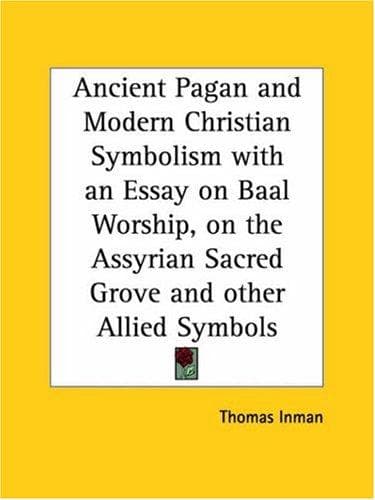
Ancient Pagan and Modern Christian Symbolism: With an Essay on Baal Worship, on the Assyrian Sacred "Grove," and Other Allied SymbolsInman, Thomas
Religion
Ancient Pagan and Modern Christian Symbolism: With an Essay on Baal Worship, on the Assyrian Sacred "Grove," and Other Allied Symbols
Inman, Thomas
Christian art and symbolism; Symbolism
So late as the advent of the Reformation, a sacred fire was kept ever
burning on a shrine at Kildare, in Ireland, and attended by virgins of
high rank, called "inghean au dagha," or daughters of fire. Every year
is the ceremony repeated at Jerusalem of the miraculous kindling of the
Holy Fire at the reputed sepulchre, and men and women crowd to light
tapers at the sacred flame, which they pass through with a naked body.
Indeed, solar myths form no unimportant part of ancient mythology. Thus
the death of nature in the winter time, through the withdrawal of the
sun, was supposed to be caused by the mourning of the earth-goddess
over the sickness and disappearance into the realms of darkness of her
husband and mate, the sun.
Mr. Fox Talbot has lately given the translation of an Egyptian poem,
more than three thousand years old, and having for its subject the
descent of Ishtar into Hades. To this region of darkness and death the
goddess goes in search of her beloved Osiris, or Tammuz. This Ishtar is
identical with the Assyrian female in the celestial quartette, the
later Phoenician Astarte, "The Queen of Heaven with crescent horns,"
the moon-goddess, also with the Greek Aphrodite and Roman Venus; and the
Egyptian legend reappears in the west as the mourning of Venus for the
loss of Adonis.
Again, the fable of Ceres mourning the death of her daughter Proserpine
is another sun-myth. The Roman Ceres was the Greek [----------], Mother
Earth, who through the winter time wanders inconsolable. Persephone,
her daughter, is the vegetable world, whose seeds or roots lie concealed
underground in the darkness of winter. These, when Spring comes with its
brightness, bud forth and dwell in the realms of light during a part of
the year, and provide ample nourishment for men and animals with their
fruits. The sun, being the active fructifying cause in nature, was
generally regarded as male. Thus, in the Jewish scriptures, he is
compared to "a bridegroom coming out of his chamber" (Ps. xix. 5), i.e.,
as a man full of generative, procreative vigour. The moon and the earth,
being receptive were naturally regarded as female.
Public-domain text, read in full here on John Shaqi.
Reviews
Reviews
No reviews yet
Be the first to share your thoughts on this work.
Elsewhere in the archive
Join the Discussion
Join the discussion
Sign in to leave a comment or review.
Sign InorCreate an account