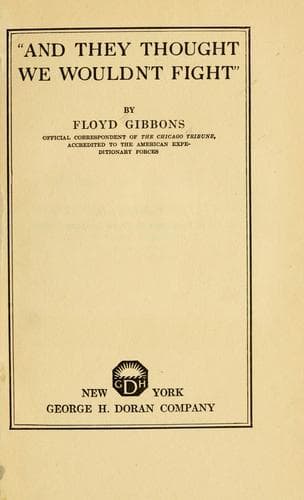
"And they thought we wouldn't fight"Gibbons, Floyd Phillips
History
"And they thought we wouldn't fight"
Gibbons, Floyd Phillips
World War, 1914-1918 -- Campaigns -- Western Front; World War, 1914-1918 -- Personal narratives
The net result of the raid was that the Germans had captured one of our
wounded men and had thereby identified the organisation opposing them as
the First Regular Division of the United States Army, composed of the
16th, 18th, 26th, and 28th Regular U. S. Infantry Regiments and the 5th,
6th and 7th Regular U. S. Army Field Artillery. The division was under
the command of Major General Robert Lee Bullard.
In the days and weeks that followed, the daily exchange of shells on the
sector increased to two and three times the number it had been before
our men arrived there. There were nightly patrols in No Man's Land and
several instances where these patrols met in the dark and engaged one
another with casualties on both sides.
One night a little over a month later--the early morning of March 4th,
to be exact--it was my privilege to witness from an exceptional vantage
point, the first planned and concentrated American artillery action
against the enemy. The German lines selected for this sudden downpour of
shell, comprised two small salients jutting out from the enemy's
positions in the vicinity of the ruined village of Lahayville, in the
same sector.
In company with an orderly who had been despatched as my guide, I
started from an artillery battalion headquarters shortly before
midnight, and together we made our way up the dark muddy road that led
through the dense Bois de la Reine to the battery positions. Half an
hour's walk and O'Neil, the guide, led me off the road into a darker
tunnel of overlaced boughs where we stumbled along on the ties of a
narrow gauge railroad that conveyed heavy shells from the road to the
guns. We passed through several gun pits and stopped in front of a huge
_abri_ built entirely above ground.
Its walls and roof must have been between five and seven feet thick and
were made from layers of logs, sandbags, railroad iron and slabs of
concrete reinforced with steel. It looked impenetrable.
"Battery commander's headquarters," O'Neil said to me as we entered a
small hot room lighted by two oil lamps and a candle. Three officers, at
two large map tables, were working on sheets of figures. Two wooden
bunks, one above the other, and two posts supporting the low ceiling
completed the meagre furnishings of the room. A young officer looked up
from his work, O'Neil saluted, and addressed him.
"The Major sent me up with this correspondent. He said you could let him
go wherever he could see the fun and that you are not responsible for
his safety." O'Neil caught the captain's smile at the closing remark and
withdrew. The captain showed me the map.
Public-domain text, read in full here on John Shaqi.
Reviews
Reviews
No reviews yet
Be the first to share your thoughts on this work.
Elsewhere in the archive
Join the Discussion
Join the discussion
Sign in to leave a comment or review.
Sign InorCreate an account