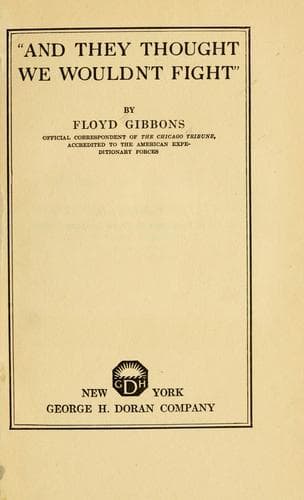
"And they thought we wouldn't fight"Gibbons, Floyd Phillips
History
"And they thought we wouldn't fight"
Gibbons, Floyd Phillips
World War, 1914-1918 -- Campaigns -- Western Front; World War, 1914-1918 -- Personal narratives
Midnight passed and we were still wheeling our way through sleeping
villages, consulting maps under rays of flashlights, gathering
directions some of the time from mile posts and wall signs, and at other
times gaining knowledge of roads and turns and hills from sleepy heads
in curl wrappers that protruded from bedroom chambers and were
over-generous in advice.
The animals were tired. Rain soaked the cigarettes and made them draw
badly. Above was drizzle and below was mud. There were a few grumbles,
but no man in our column would have traded places with a brother back
home even if offered a farm to boot.
It was after three in the morning when we parked the guns in front of a
chateau, brought forward some lagging combat wagons and discovered the
rolling kitchen had gone astray. In another hour the animals had been
unhitched but not unharnessed, fed and watered in darkness and the men,
in utter weariness, prepared to lie down and sleep anywhere. At this
juncture, word was passed through the sections that the battery would
get ready to move immediately. Orders were to clear the village by six
o'clock. Neither men nor horses were rested, but we moved out on time
and breakfasted on the road.
The way seemed long, the roads bad and the guns heavy. But we were
passing through an Eden of beauty--green fields and rolling hills
crested by ancient chateaux. At times, the road wound down through
hillside orchards, white and pink with apple blooms. Fatigue was heavy
on man and beast, but I heard one walking cannoneer singing, "When It's
Apple Blossom-time in Normandie." Another rider in the column recalled
the time when his father used to give him ten cents for standing on the
bottom of an upturned tin basin and reciting, "Over the mountains
winding down, horse and foot into Frederickstown."
"The jar of these guns as they grind over the gravel is enough to grind
the heart out of you," said a sweating cannoneer who was pressing a
helping shoulder to one of the heavies as we negotiated a steep hill.
"What in hell you kicking about," said the man opposite. "Suppose you
was travelling with one of them guns the Germans are using on Paris--I
mean that old John J. Longdistance. You'd know what heavy guns are then.
They say that the gun's so big and takes so many horses to haul it, that
the man who drives the lead pair has never spent the night in the same
town with the fellow who rides wheel swing."
A young reserve lieutenant with mind intensely on his work, combined for
my benefit his impressions of scenery with a lesson in artillery
location. His characterisation of the landscape was as technical as it
was unpoetical.
"A great howitzer country," was the tenor of his remarks. "Look at the
bottom of that slide. Fine position for one fifty-five. Take that gully
over there. That's a beaut of a place. No use talking. Great howitzer
country."
Public-domain text, read in full here on John Shaqi.
Reviews
Reviews
No reviews yet
Be the first to share your thoughts on this work.
Elsewhere in the archive
Join the Discussion
Join the discussion
Sign in to leave a comment or review.
Sign InorCreate an account