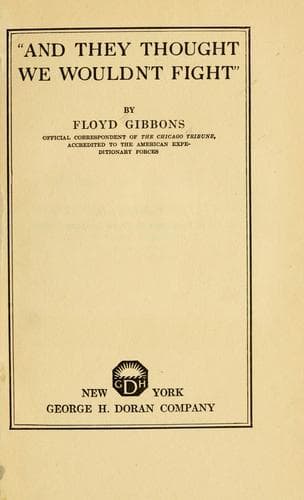
"And they thought we wouldn't fight"Gibbons, Floyd Phillips
History
"And they thought we wouldn't fight"
Gibbons, Floyd Phillips
World War, 1914-1918 -- Campaigns -- Western Front; World War, 1914-1918 -- Personal narratives
The dealings were not in bushels of wheat or shares in oils or rails.
Delicacies were the bartered commodities and of these, eggs were the
strongest. The German intelligence service could have found no surer way
to trace the peregrinations of American troops about France, than to
follow up the string of eggless villages they left behind them.
As soon as billets were located, those without extra duty began the egg
canvass of the town. There was success for those who made the earliest
start and struck the section with the most prolific hens. Eggs were
bought at various prices before news of the American arrivals had caused
peasants to set up a new scale of charges. The usual late starter and
the victim of arrangements was the officer's striker who lost valuable
time by having to take care of his officer's luggage and get the latter
established in billets. It was then his duty to procure eggs for the
officer's mess.
By that time, all natural egg sources had been obliterated and the only
available supply was cornered by the soldiers' board of trade. The
desired breakfast food could be obtained in that place only. It was the
last and only resort of the striker, who is euphoniously known as a dog
robber. In the board of trade he would find soldiers with helmets full
of eggs which could be bought at anywhere from two to three times their
original price. It was only by the payment of such prices that the
officer was able to get anything that could possibly leave a trace of
yellow on his chin. If there was a surplus, the soldiers themselves had
ample belt room to accommodate it.
In one village tavern, I saw one soldier eat fourteen eggs which he
ordered Madame to fry in succession. I can believe it because I saw it.
Madame saw it also, but I feel that she did not believe her eyes. A
captain of the Judge Advocate's office also witnessed the gastronomic
feat.
"Every one of those eggs was bought and paid for," he said. "Our
department handles claims for all stolen or destroyed property and we
have yet to receive the first claim from this town. Of course every one
knows that a hungry man will steal to eat and there are those who hold
that theft for the purpose of satisfying demands of the stomach is not
theft. But our records show that the American soldier in France is ready
to, willing to, and capable of buying what he needs outside of his
ration allowance.
"We have some instances of stealing, but most of them are trivial.
Recently, we took from the pay of one whole battalion the cost of
thirty-one cheeses which were taken from a railroad restaurant counter.
The facts were that some of our troops en route were hungry and the
train was stopping only for five minutes and the woman behind the
counter didn't have time to even take, much less change, the money
offered, so the men grabbed the cheeses and ran out just in time to
board the train as it was moving off.
Public-domain text, read in full here on John Shaqi.
Reviews
Reviews
No reviews yet
Be the first to share your thoughts on this work.
Elsewhere in the archive
Join the Discussion
Join the discussion
Sign in to leave a comment or review.
Sign InorCreate an account