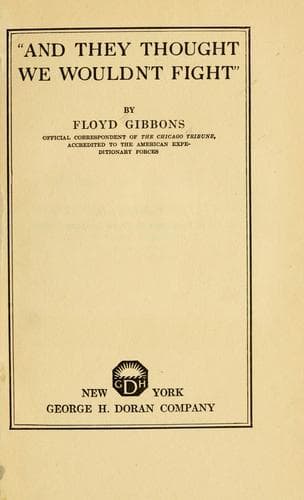
"And they thought we wouldn't fight"Gibbons, Floyd Phillips
History
"And they thought we wouldn't fight"
Gibbons, Floyd Phillips
World War, 1914-1918 -- Campaigns -- Western Front; World War, 1914-1918 -- Personal narratives
Every head was down when the explosion came. Branches and pieces of tree
trunk were whirled upward, and the air became populated with deadly
bumble bees and humming birds, for such is the sound that the shell
splinters make. When I essayed our shell hole afterward, I couldn't
fathom how five of us had managed to accommodate ourselves in it, but in
the rush of necessity, no difficulty had been found.
Passing from the woods forward, one by one, over a bald field, we
skirted a village that was being heavily shelled, and reached a trench
on the side of the hill in direct view of the German positions. The
enemy partially occupied the ruined village of Cantigny not eight
hundred yards away, but our glasses were unable to pick up the trace of
a single person in the debris. French shells, arriving endlessly in the
village, shot geysers of dust and wreckage skyward. It was from this
village, several days later, that our infantry patrols brought in
several prisoners, all of whom were suffering from shell shock. But our
men in the village opposite underwent the same treatment at the hands of
the German artillery.
It was true of this sector that what corresponded to the infantry front
line was a much safer place to be in than in the reserve positions, or
about the gun pits in villages or along roads in our back area. Front
line activity was something of minor consideration, as both sides seemed
to have greater interests at other points and, in addition to that, the
men of both sides were busy digging trenches and shelters. There were
numerous machine gun posts which swept with lead the indeterminate
region between the lines, and at night, patrols from both sides explored
as far as possible the holdings of the other side.
Returning to the battalion headquarters that night by a route apparently
as popular to German artillery as was the one we used in the forenoon,
we found a telephone switchboard in full operation in the sub-cellar,
and mess headquarters established in a clean kitchen above the ground.
Food was served in the kitchen and we noticed that one door had suffered
some damage which had caused it to be boarded up and that the plaster
ceiling of the room was full of fresh holes and rents in a dozen places.
At every shock to the earth, a little stream of oats would come through
the holes from the attic above. These falling down on the officer's neck
in the midst of a meal, would have no effect other than causing him to
call for his helmet to ward off the cereal rain.
We learned more about the sinister meaning of that broken door and the
ceiling holes when it became necessary later in the evening to move mess
to a safer location. The kitchen was located just thirty yards back of
the town cross roads and an unhealthy percentage of German shells that
missed the intersection caused too much interruption in our cook's work.
Public-domain text, read in full here on John Shaqi.
Reviews
Reviews
No reviews yet
Be the first to share your thoughts on this work.
Elsewhere in the archive
Join the Discussion
Join the discussion
Sign in to leave a comment or review.
Sign InorCreate an account