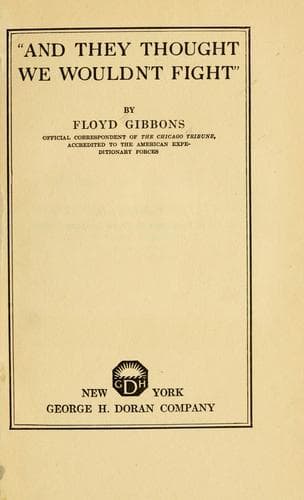
"And they thought we wouldn't fight"Gibbons, Floyd Phillips
History
"And they thought we wouldn't fight"
Gibbons, Floyd Phillips
World War, 1914-1918 -- Campaigns -- Western Front; World War, 1914-1918 -- Personal narratives
"We are sending over a little party of new boys just for practice and a
'look-see' in Hunland. We have two companies in this regiment which feel
they've sorter been left out on most of the fun to date, so this affair
has been arranged for them. We put the plans together last week and
pushed the boys through three days of training for it back of the
lines. They're fit as fiddlers to-night and it looks like there'll be no
interruption to their pleasure.
"No one man in the world, be he correspondent or soldier, could see
every angle of even so small a thing as a little raid like this," the
Colonel explained. "What you can't see you have got to imagine. I'm
suggesting that you stay right in here for the show. That telephone on
my adjutant's desk is the web centre of all things occurring in this
sector to-night and the closer you are to it, the more you can see and
learn. Lieutenant Warren will take you up the road first and give you a
look out of the observatory, so you'll know in what part of Germany our
tourists are going to explore."
Darkness had fallen when we emerged, but there were sufficient stars out
to show up the outline of the gaping walls on either side of our way. We
passed a number of sentries and entered a black hole in the wall of a
ruin. After stumbling over the uneven floor in a darkened passage for
some minutes, we entered a small room where several officers were
gathered around a table on which two burning candles were stuck in
bottles. Our guide, stepping to one end of the room, pulled aside a
blanket curtain and passed through a narrow doorway. We followed.
Up a narrow, steep, wooden stairway between two walls of solid masonry,
not over two feet apart, we passed, and arrived on a none too stable
wooded runway with a guide rail on either side. Looking up through the
ragged remains of the wooden roof frame, now almost nude of tiles, we
could see the starry sky. Proceeding along the runway, we arrived,
somewhere in that cluster of ruins, in a darkened chamber whose
interior blackness was relieved by a lighter slit, an opening facing
the enemy.
Against the starry skyline, we could see the black outline of a flat
tableland in the left distance which we knew to be that part of the
heights of Meuse for whose commanding ridge there have been so many
violent contests between the close-locked lines in the forest of
Apremont. More to the centre of the picture, stood Mont Sec, detached
from the range and pushing its summit up through the lowland mist like
the dorsal fin of a porpoise in a calm sea. On the right the lowland
extended to indistinct distances, where it blended with the horizon.
In all that expanse of quiet night, there was not a single flicker of
light, and at that time not a sound to indicate that unmentionable
numbers of our men were facing one another in parallel ditches across
the silent moor.
Public-domain text, read in full here on John Shaqi.
Reviews
Reviews
No reviews yet
Be the first to share your thoughts on this work.
Elsewhere in the archive
Join the Discussion
Join the discussion
Sign in to leave a comment or review.
Sign InorCreate an account