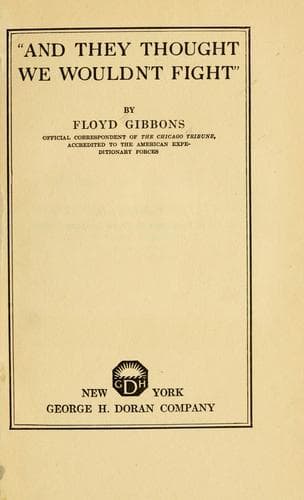
"And they thought we wouldn't fight"Gibbons, Floyd Phillips
History
"And they thought we wouldn't fight"
Gibbons, Floyd Phillips
World War, 1914-1918 -- Campaigns -- Western Front; World War, 1914-1918 -- Personal narratives
Along the line of march, traffic piled up at the street intersections
and the gendarmes were unable to prevent the crowds from overflowing the
sidewalks and pressing out into the streets where they could smile their
greetings and throw flowers at closer range. A sergeant flanking a
column stopped involuntarily when a woman on the curb reached out,
grabbed his free hand, and kissed it. A snicker ran through the platoon
as the sergeant, with face red beneath the tan, withdrew his hand and
recaught his step. He gave the snickering squads a stern, "Eyes front!"
and tried to look at ease.
How the bands played that day! How the crowds cheered! How the flags and
handkerchiefs and hats waved in the air, and how thousands of throats
volleyed the "Vive's!" This was the reception of our first fighting men.
But on the following day they received even a greater demonstration,
when they marched through the streets of the city on parade, and
participated in the first Parisian celebration of American Independence
Day.
Parisians said that never before had Paris shown so many flags, not even
during the days three years before, when the sons of France had marched
away to keep the Germans out of Paris. It seemed that the customary
clusters of Allied flags had been almost entirely replaced for the day
by groups composed solely of the French tri-colour and the Stars and
Stripes. Taxis and fiacres flew flags and bunting from all attachable
places. Flag venders did wholesale business on the crowded streets.
Street singers sang patriotic parodies, eulogising Uncle Sam and his
nephews, and garnered harvests of sous for their efforts.
The three companies of our regulars marched with a regiment of French
colonials, all veterans of the war and many of them incapacitated for
front service through wounds and age. French soldiers on leave from the
trenches and still bearing the mud stains of the battle front life,
cheered from the sidewalks. Bevies of middinettes waved their aprons
from the windows of millinery shops. Some of them shouted, "Vive les
Teddies!" America--the great, good America--the sister republic from
across the seas was spoken of and shouted all day long. Paris
capitulated unconditionally to three companies of American infantry.
From that day on, every American soldier visiting Paris has been made to
feel himself at home. And the unrestricted hospitality did not seem to
be the result of an initial wave of enthusiasm. It was continuous. For
months afterward, any one wearing an American uniform along the
boulevards could hear behind him dulcet whispers that carried the words
_tres gentil_.
Public-domain text, read in full here on John Shaqi.
Reviews
Reviews
No reviews yet
Be the first to share your thoughts on this work.
Elsewhere in the archive
Join the Discussion
Join the discussion
Sign in to leave a comment or review.
Sign InorCreate an account