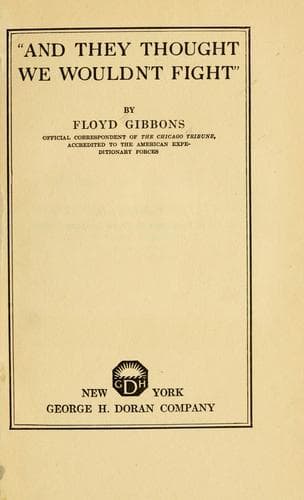
"And they thought we wouldn't fight"Gibbons, Floyd Phillips
History
"And they thought we wouldn't fight"
Gibbons, Floyd Phillips
World War, 1914-1918 -- Campaigns -- Western Front; World War, 1914-1918 -- Personal narratives
The theatres of Paris offered a continual change of amusement. One of
the most popular among these was the Folies Bergeres. Some of our men
didn't realise until after they entered the place that it was a French
theatre. Due to the French pronunciation of the name, some of the
American soldiers got the idea that it was a saloon run by an Irishman
by the name of Foley. "Bergere" to some was unpronounceable, so the
Folies Bergeres was most popularly known in our ranks as "Foley's
place."
Another popular amusement place was the Casino de Paris, where an echo
from America was supplied by an American negro jazz band, which
dispensed its questionable music in the _promenoir_ during the
intermission. There were five negroes in the orchestra and each one of
them seemed to have an ardent dislike for the remaining four.
Individually they manifested their mutual contempt by turning their
backs on one another while they played. Strange as it may seem, a most
fascinating type of harmony resulted, producing much swaying of
shoulders, nodding of heads and snapping of fingers among the American
soldiers in the crowd. French men and women, with their old world
musical taste, would consider the musical gymnastics of the demented
drummer in the orchestra, then survey the swaying Americans and come to
the conclusion that the world had gone plumb to hell.
All types of American soldiers made Paris their mecca as soon as the
desired permissions had been granted. One day I sat opposite a
remarkable type whom I found dining in a small restaurant. I noticed the
absence of either beer or wine with his meal, and he frankly explained
that he had never tasted either in his life. He thanked me, but refused
to accept a cigarette I offered, saying without aside that he had yet
his first one to smoke. When I heard him tell Madame that he did not
care for coffee, I asked him why, and he told me that his mother had
always told him it was injurious and he had never tasted it.
I became more interested in this ideal, young American soldier and
questioned him about his life. I found that he and his father had worked
in the copper mines in Michigan. They were both strong advocates of
union labour and had participated vigorously in the bloody Michigan
strikes.
"Father and I fought that strike clear through," he said. "Our union
demands were just. Here in this war I am fighting just the same way as
we fought against the mine operators in Michigan. I figure it out that
Germany represents low pay, long hours and miserable working conditions
for the world. I think the Kaiser is the world's greatest scab. I am
over here to help get him."
* * * * *
Public-domain text, read in full here on John Shaqi.
Reviews
Reviews
No reviews yet
Be the first to share your thoughts on this work.
Elsewhere in the archive
Join the Discussion
Join the discussion
Sign in to leave a comment or review.
Sign InorCreate an account