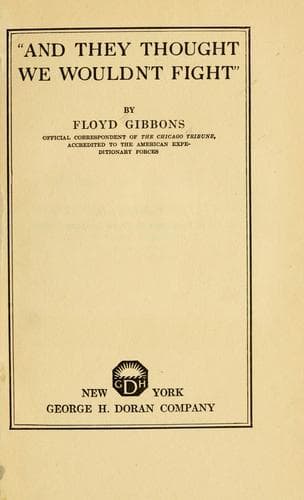
"And they thought we wouldn't fight"Gibbons, Floyd Phillips
History
"And they thought we wouldn't fight"
Gibbons, Floyd Phillips
World War, 1914-1918 -- Campaigns -- Western Front; World War, 1914-1918 -- Personal narratives
"Holy Mother!" replies Moriarity, kicking off one boot and hopping on
one foot toward the stables. "Take it, you scamp, and I hopes you get it
filled wid dimonds and gold dust. But mind ye, if you get it too near
the fire and burn the rubber I'll eat you like you was a oyster."
The Irish giant emphasised his threat with a grimace of red-whiskered
ferocity and concluded by loudly smacking his lips. Then little Pierre
was off to his mother's cottage, dragging the seven league boot after
him.
With the afternoon meal, the last of the packages had been tied with red
cords and labelled, and the interior of the Colonel's quarters looked
like an express office in the rush season. The packages represented the
purchases made with 1,300 francs which the men of the battalion had
contributed for the purpose of having Christmas come to Saint Thiebault
in good style.
M. Lecompte has finished sewing the red and white covering which is to
be worn by "Hindenburg," the most docile mule in the wagon train, upon
whom has fallen the honour of drawing the present loaded sleigh of the
Christmas saint.
"Red" Powers, the shortest, fattest and squattiest man in the
battalion, is investing himself with baggy, red garments, trimmed with
white fur and tassels, all made out of cloth by hands whose familiarity
with the needle has been acquired in bayonet practice. Powers has donned
his white wig and whiskers and his red cap, tasseled in white. He is
receiving his final instructions from the colonel.
"You may grunt, Powers," the colonel is saying, "but don't attempt to
talk French with that Chicago accent. We don't want to frighten the
children. And remember, you are not Santa Claus. You are Papa Noel.
That's what the French children call Santa Claus."
It is three o'clock, and the regimental band, assembled in marching
formation in the village street, blares out "I Wish I Were in the Land
of Cotton," and there is an outpouring of children, women and soldiers
from every door on the street. The colonel and his staff stand in front
of their quarters opposite the band, and a thousand American soldiers,
in holiday disregard for formation, range along either side of the
street.
The large wooden gate of the stable yard, next to the commandant's
quarters, swings open; there is a jingle of bells, and "Hindenburg,"
resplendent in his fittings, and Papa Noel Powers sitting high on the
package-heaped sleigh, move out into the street. Their appearance is met
with a crash of cymbals, the blare of the band's loudest brass, and the
happy cries of the children and the deeper cheers of the men.
Christmas had come to Saint Thiebault. Up the street went the
procession, the band in the lead playing a lively jingling piece of
music well matched to the keenness of the air and the willingness of
young blood to tingle with the slightest inspiration.
Public-domain text, read in full here on John Shaqi.
Reviews
Reviews
No reviews yet
Be the first to share your thoughts on this work.
Elsewhere in the archive
Join the Discussion
Join the discussion
Sign in to leave a comment or review.
Sign InorCreate an account