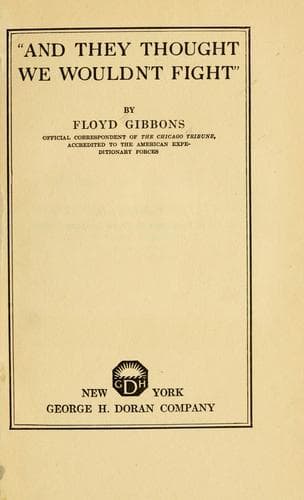
"And they thought we wouldn't fight"Gibbons, Floyd Phillips
History
"And they thought we wouldn't fight"
Gibbons, Floyd Phillips
World War, 1914-1918 -- Campaigns -- Western Front; World War, 1914-1918 -- Personal narratives
"And all the chinks to be filled up with nuts and figs, and sweets.
_Voila_, Pierre," and with these words, he had poured the sweetmeats in
overflowing measure into the biggest hip boot in the regiment.
Amid the cheers of the men, led by big Moriarity, Pierre started toward
his seat, struggling with the seven league boot and the wholesale booty,
and satisfied with the realisation that in one haul he had obtained more
than his companions in five.
Company B quartet sang "Down in a Coal Hole," and then, as the band
struck up outside the church, all moved to the street. The sun had gone
down, the early winter night had set in, and the sky was almost dark.
"Signal for the barrage," came the command in the darkness.
There were four simultaneous hisses of fire and four comets of flame
sprang up from the ground. They broke far overhead in lurid green.
"Signal for enemy planes overhead," was the next command, and four more
rockets mounted and ended their flights in balls of luminous red. Other
commands, other signals, other rockets, other lights and flares and
pistol star shells, enriched a pyrotechnical display which was
economically combined with signal practice.
The red glare illuminated the upturned happy faces of American and
French together. Our men learned to love the French people. The French
people learned to love us.
CHAPTER XV
CHATEAU-THIERRY AND THE BOIS DE BELLEAU
I have endeavoured to show in preceding chapters the development of the
young American army in France from a mere handful of new troops up to
the creation of units capable of independent action on the front. Only
that intense and thorough training made it possible for our oversea
forces to play the veteran part they did play in the great Second Battle
of the Marne.
The battle developed as a third phase of the enemy's Western Front
offensives of the year. The increasing strength of the American forces
overseas forced Germany to put forth her utmost efforts in the forlorn
hope of gaining a decision in the field before the Allied lines could
have the advantage of America's weight.
On March 21st, the Germans had launched their first powerful offensive
on a front of fifty miles from Arras to Noyon in Picardy and had
advanced their lines from St. Quentin to the outskirts of Amiens.
On April 9th, the German hordes struck again in Flanders on a front of
twenty miles from Lens northward to the River Lys and had cut into the
Allied front as far as Armentieres.
There followed what was considered an abnormal delay in the third act of
the demonstration. It was known that the Germans were engaged in making
elaborate arrangements for this mid-summer push. It was the enemy hope
in this great offensive to strike a final effective blow against the
hard-pressed Allied line before America's rising power could be thrown
into the fight.
Public-domain text, read in full here on John Shaqi.
Reviews
Reviews
No reviews yet
Be the first to share your thoughts on this work.
Elsewhere in the archive
Join the Discussion
Join the discussion
Sign in to leave a comment or review.
Sign InorCreate an account