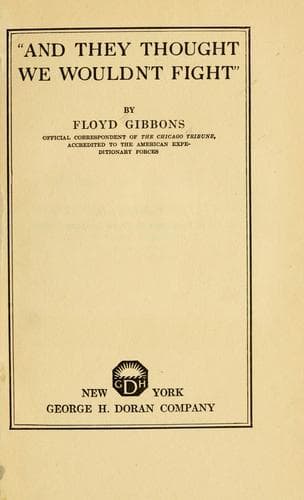
"And they thought we wouldn't fight"Gibbons, Floyd Phillips
History
"And they thought we wouldn't fight"
Gibbons, Floyd Phillips
World War, 1914-1918 -- Campaigns -- Western Front; World War, 1914-1918 -- Personal narratives
Along the south bank of the river at that place, the Paris-Chalons ran
through a number of deep cuts and one tunnel. The enemy took shelter in
these natural protections. They suffered serious losses from the Allied
artillery which also destroyed some of their pontoons across the river,
but in spite of this, the Germans succeeded in re-enforcing the units on
the south bank to the strength of about a battalion.
Almost at the same time, the French defenders at this place received
re-enforcements from the Americans. Units of the 3rd United States
Regular Division and the 28th U. S. Division, comprised largely of
Pennsylvania National Guardsmen, were rushed forward from training
areas, miles back of the line, where they were engaged in fitting
themselves for line duty. These incompletely trained American units
abandoned their bayonet-stabbing of gunny-sacks and make-believe warfare
to rush forward into the real thing.
On June 2nd, these Americans, under command of French officers, began
the counter attack to sweep the Germans back from the south bank. By
that time the enemy had succeeded in putting twenty-two light bridges
across the Marne and had established a strong bridgehead position with a
number of machine guns and a strong force of men in the railway station
on the south bank of the river opposite Jaulgonne.
This position was attacked frontally by the Americans and French. Our
novices in battle were guilty of numerous so-called strategical
blunders, but in the main purpose of killing the enemy, they proved
irresistible. The Germans broke and ran. At the same time, the French
artillery lowered a terrific barrage on the bridges crossing the river,
with the result that many of the fleeing enemy were killed and more
drowned. Only thirty or forty escaped by swimming. One hundred of them
threw down their arms and surrendered. The remainder of the battalion
was wiped out. At the close of the engagement the Americans and the
French were in full command of the south bank.
But it was in Chateau-Thierry itself that the Germans made their most
determined effort to cross the river and get a footing on the south
bank, and it was there, again, that their efforts were frustrated by our
forces. On May 31st, American machine gun units, then in training
seventy-five kilometres south of the Marne, were hurriedly bundled into
motor lorries and rushed northward into Chateau-Thierry.
The Germans were advancing their patrols into the north side of the
city. They were pouring down the streets in large numbers, with the
evident purpose of crossing the bridges and establishing themselves on
the south bank.
It was four o'clock in the afternoon of May 31st that those American
machine gunners got their first glimpse of real war. That night while
the German artillery raked the south bank of the river with high
explosive shells, those Americans, shouldering their machine guns,
marched into the city and took up defensive positions on the south bank
of the river.
Public-domain text, read in full here on John Shaqi.
Reviews
Reviews
No reviews yet
Be the first to share your thoughts on this work.
Elsewhere in the archive
Join the Discussion
Join the discussion
Sign in to leave a comment or review.
Sign InorCreate an account