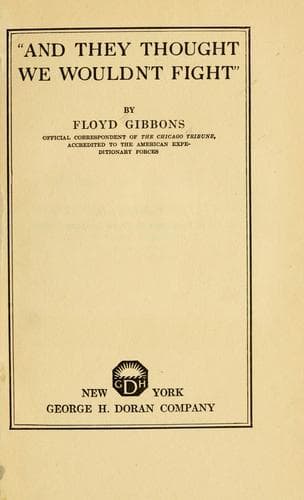
"And they thought we wouldn't fight"Gibbons, Floyd Phillips
History
"And they thought we wouldn't fight"
Gibbons, Floyd Phillips
World War, 1914-1918 -- Campaigns -- Western Front; World War, 1914-1918 -- Personal narratives
American doctors and American nurses, both by their skill and care and
tenderness, nursed that little fellow back to complete recovery, made
him remember everything and shortly afterward, well and cured, he
started back, safe and sound, to his home in Tennessee.
Nothing I can ever say will overstate my estimation of the credit that
is deserved by our American doctors and nurses for the great work they
are doing. I am not alone in knowing this. I call to witness any
Canadian, Englishman or Frenchman, that, if he is wounded, when in the
ambulance, he usually voices one request, "Take me to an American
hospital."
I knew of one man who entered that United States Military Base Hospital
near Paris, with one bullet through the shoulder, another through an
arm, an eye shot out and a compound fracture of the skull, and those
American doctors and nurses by their attention and skilfulness made it
possible for him to step back into boots and breeches and walk out of
the hospital in ten days.
It so happens that I am somewhat familiar with the details in that case
because I am the man.
CHAPTER XIX
"JULY 18TH"--THE TURN OF THE TIDE
Through the steady growth of Marshal Foch's reserves, by the speedy
arrival of American forces, the fourth German offensive of 1918, the
personally directed effort launched by the Crown Prince on May 27th, had
been brought to a standstill.
The German thrust toward Paris had been stopped by the Americans at
Chateau-Thierry and in the Bois de Belleau. It would be an injustice not
to record the great part played in that fighting by the French Army
attacked, but it would be equally unjust not to specify as the French
have gallantly done, that it was the timely arrival of American strength
that swung the balance against the enemy. For the remainder of that
month of June and up to the middle of July, the fighting was considered
local in its character.
The German offensive had succeeded in pushing forward the enemy front
until it formed a loop extending southward from the Aisne to the Valley
of the Marne. This salient was called the Chateau-Thierry pocket. The
line ran southward from a point east of Soissons to Chateau-Thierry,
where it touched the Marne, thence eastward along both sides of the
river to the vicinity of Oeuilly where it recrossed the Marne and
extended northward to points beyond Rheims.
Chateau-Thierry was thus the peak of the German push--the apex of the
triangle pointing toward Paris. The enemy supplied its forces in this
peak principally by the road that ran southward from Soissons and
touched the Marne at Chateau-Thierry. To the west of this road and just
south of the city of Soissons, is the forest of Villers-Cotterets. The
enemy occupied the northern and eastern limits of the forest and the
remainder of it was in the hands of the French.
Public-domain text, read in full here on John Shaqi.
Reviews
Reviews
No reviews yet
Be the first to share your thoughts on this work.
Elsewhere in the archive
Join the Discussion
Join the discussion
Sign in to leave a comment or review.
Sign InorCreate an account