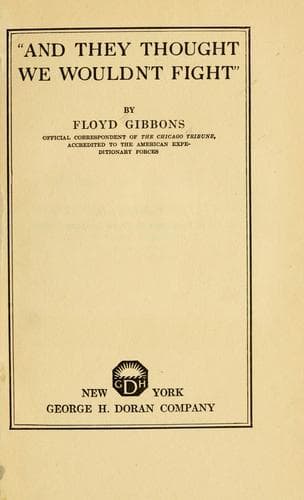
"And they thought we wouldn't fight"Gibbons, Floyd Phillips
History
"And they thought we wouldn't fight"
Gibbons, Floyd Phillips
World War, 1914-1918 -- Campaigns -- Western Front; World War, 1914-1918 -- Personal narratives
This protracted delay of an impending blow worried the enemy. The
Germans realised full well that they were fighting against time. Their
faith in the capacity of their submarines to prevent American strength
from reaching the line, had been abandoned. They now knew that every day
that passed meant just that many more American soldiers arriving in
France, and the consequent strengthening of the Allied forces during a
season when the Germans, through their repeated offensives, were
suffering terrible losses and were consequently growing weaker.
So, on July 14th, when the Allied counter-offensive had still failed to
materialise, the German forces, by the necessity for time, moved to a
sudden and faulty decision. They convinced themselves that they had
overestimated the Allied strength. They accepted the belief that the
reason Foch had not attacked was because he did not have sufficient
strength to attack. With this, then, as a basis for their plans, they
immediately launched another offensive, hoping that this might be the
one in which they could deliver the final blow.
This action began on Monday morning, July 15th, and extended from
Chateau-Thierry eastward along the valley of the Maine, northward to
Rheims and thence eastward. By a remarkable coup, one small patrol of
French and Americans deprived the enemy of the element of surprise in
the attack. On the morning of the previous day, this patrol successfully
raided the enemy lines to the east of Rheims and brought back prisoners
from whom it was learned that the Germans intended striking on the
following morning. The objectives of the offensive were the French
cities of Epernay and Chalons. The accomplishment of this effort would
have placed the Rheims salient in the hands of the enemy and brought the
German lines southward to positions straddling the Marne, down the
valley of which they would thus be able to launch another offensive on a
straight road to Paris.
The Germans needed considerable strength for this new effort. To muster
the shock divisions necessary for the attack, they had to weaken their
lines elsewhere. The first reserves that they drew for this offensive
were the Prussian Guard divisions which they had been holding in
readiness in back of the weak spot in their line in the
Villers-Cotterets Forest. Those divisions were hurriedly transported
across the base of the V-shaped salient and thrown into the attack to
the east and the southwest of Rheims.
The Germans found the Allied line prepared to receive them. Their
attacking waves were mowed down with terrific machine gun fire from
French and American gunners, while at the same time heavy artillery
barrages played upon the German back areas with deadly effect in the
massed ranks of the reserves. The fighting was particularly vicious. It
was destined to be the Germans' last action of a grand offensive nature
in the entire war.
Public-domain text, read in full here on John Shaqi.
Reviews
Reviews
No reviews yet
Be the first to share your thoughts on this work.
Elsewhere in the archive
Join the Discussion
Join the discussion
Sign in to leave a comment or review.
Sign InorCreate an account