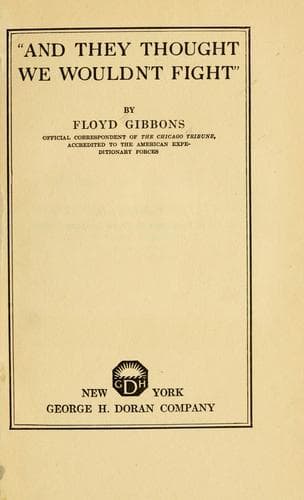
"And they thought we wouldn't fight"Gibbons, Floyd Phillips
History
"And they thought we wouldn't fight"
Gibbons, Floyd Phillips
World War, 1914-1918 -- Campaigns -- Western Front; World War, 1914-1918 -- Personal narratives
The town had been systematically pillaged. The German soldiers had
looted from the shops much material which they had made up into packages
to be mailed back to home folks in the Fatherland. The church, strangely
enough, was picked out as a depository for their larcenies. Nothing from
the robes of the priests down to the copper faucet of a water pipe had
escaped their greed.
The advancing Americans did not linger in the town--save for small
squads of engineers that busied themselves with the removal of the
street obstructions and the supply organisations that perfected
communication for the advancing lines. These Americans were Yankees
all--they comprised the 26th U. S. Division, representing the National
Guard of New England.
Our lines kept pushing to the north. The Germans continued their
withdrawal and the Allied necessity was to keep contact with them. This,
the Yankee Division succeeded in doing. The first obstacle encountered
to the north of Chateau-Thierry was the stand that the Germans made at
the town of Epieds.
On July 23rd, our infantry had proceeded up a ravine that paralleled the
road into Epieds. German machine guns placed on the hills about the
village, swept them with a terrible fire. Our men succeeded in reaching
the village, but the Germans responded with such a terrific downpour of
shell that our weakened ranks were forced to withdraw and the Germans
re-entered the town.
On the following day we renewed the attack with the advantage of
positions which we had won during the night in the Bois de Trugny and
the Bois de Chatelet. We advanced from three sides and forced the
Germans to evacuate. Trugny, the small village on the edge of the woods,
was the scene of more bloody fighting which resulted in our favour.
Further north of Epieds, the Germans having entrenched themselves along
the roadway, had fortified the same with a number of machine guns which
commanded the flat terrain in such a way as to make a frontal attack by
infantry waves most costly. The security of the Germans in this position
received a severe shock when ten light automobiles, each one mounting
one or two machine guns, started up the road toward the enemy, firing as
they sped. It was something new. The Germans wanted to surrender, but
the speed of the cars obviated such a possibility. So the enemy fled
before our gasoline cavalry.
The Germans were withdrawing across the river Ourcq, whose valley is
parallel to that of the Marne and just to the north. The enemy's
intentions of making a stand here were frustrated by violent attacks,
which succeeded in carrying our forces into positions on the north side
of the Ourcq. These engagements straightened out the Allied line from
the Ourcq on the west to Fere-en-Tardenois on the east, which had been
taken the same day by French and American troops.
Public-domain text, read in full here on John Shaqi.
Reviews
Reviews
No reviews yet
Be the first to share your thoughts on this work.
Elsewhere in the archive
Join the Discussion
Join the discussion
Sign in to leave a comment or review.
Sign InorCreate an account