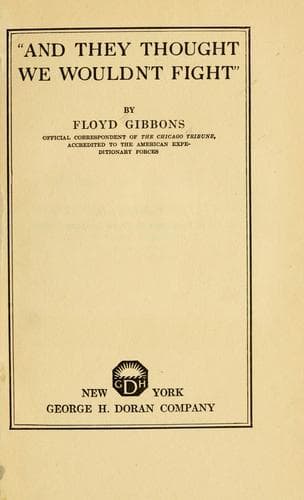
"And they thought we wouldn't fight"Gibbons, Floyd Phillips
History
"And they thought we wouldn't fight"
Gibbons, Floyd Phillips
World War, 1914-1918 -- Campaigns -- Western Front; World War, 1914-1918 -- Personal narratives
"On Aug. 4th the infantry combats were localized with terrible fury.
The outskirts of Fismes were solidly held by the Germans, where their
advance groups were difficult to take. The Americans stormed them and
reduced them with light mortars and thirty-sevens. They succeeded,
though not without loss, and at the end of the day, thanks to this
slow but sure tenacity, they were within one kilometre of Fismes and
masters of Villes, Savoye and Chezelle Farm. All night long rains
hindered their movements and rendered their following day's task more
arduous. On their right the French had, by similar stages, conquered
a series of woods and swamps of Meuniere Woods, to the east of St.
Gilles, and were on the plateau of Bonne Maison Farm. To the left
another American unit had been able to advance upon the Vesle to the
east of St. Thiebault.
"On Aug. 5th the artillery prepared for the attack on Fismes by a
bombardment, well regulated, and the final assault was launched. The
Americans penetrated into the village and then began the mean task of
clearing the last point of resistance. That evening this task was
almost completed. We held all the northern part of the village as far
as Rheims road, and patrols were sent into the northern end of the
village. Some even succeeded in crossing the Vesle, but were satisfied
with making a reconnaissance, as the Germans still occupied the right
bank of the river in great strength. All that was left to be
accomplished was to complete the mopping up of Fismes and the
strengthening of our positions to withstand an enemy counter attack.
"Such was the advance of one American division, which pushed the enemy
forward from Roncheres on July 30th a distance of eighteen kilometres
and crowned its successful advance with the capture of Fismes on Aug.
5th."
The German line on the Vesle river fell shortly after the capture of
Fismes. The enemy was forced to fall back to his next natural line of
defence on the Aisne. Between the Vesle and the Aisne, the Americans
assisted the French in the application of such persistent pressure that
the enemy's stubborn resistance was overcome and in many places he was
forced to withdraw before he had time to destroy his depots of supply.
On August 9th, General Degoutte, commanding the Sixth French Army,
issued the following order:
"Before the great offensive of July 18th, the American troops, forming
part of the 6th French Army, distinguished themselves by clearing the
'Brigade de Marine' Woods and the village of Vaux of the enemy and
arresting his offensive on the Marne and at Fossoy.
"Since then they have taken the most glorious part in the second
battle of the Marne, rivalling the French troops in ardour and valour.
"During twenty days of constant fighting they have freed numerous
French villages and made, across a difficult country, an advance of
forty kilometres, which has brought them to the Vesle.
Public-domain text, read in full here on John Shaqi.
Reviews
Reviews
No reviews yet
Be the first to share your thoughts on this work.
Elsewhere in the archive
Join the Discussion
Join the discussion
Sign in to leave a comment or review.
Sign InorCreate an account