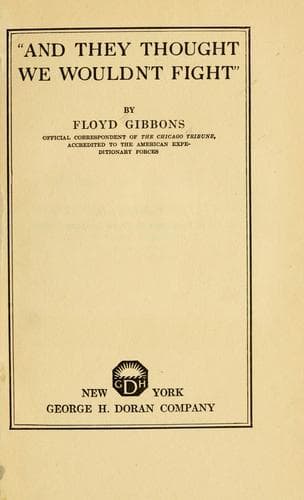
"And they thought we wouldn't fight"Gibbons, Floyd Phillips
History
"And they thought we wouldn't fight"
Gibbons, Floyd Phillips
World War, 1914-1918 -- Campaigns -- Western Front; World War, 1914-1918 -- Personal narratives
The personnel of this, the greatest single army that ever fought beneath
the Stars and Stripes, is reproduced in the appendix. It might not be
amiss to point out that an American division numbers thirty thousand
men and that an American corps consists of six divisions and auxiliary
troops, such as air squadrons, tank sections, and heavy artillery, which
bring the strength of an American army corps to between 225,000 and
250,000 men. By the 1st of September, the United States of America had
five such army corps in the field, martialling a strength of about one
and one-half million bayonets. General Pershing was in command of this
group of armies which comprised the First American Field Army.
It was from these forces that General Pershing selected the strong units
which he personally commanded in the first major operation of the First
American Field Army as an independent unit in France. That operation was
the beginning of the Pershing push toward the Rhine--it was the Battle
of St. Mihiel.
It was a great achievement. It signalised the full development of our
forces from small emergency units that had reached the front less than a
year before, to the now powerful group of armies, fighting under their
own flag, their own generals, and their own staffs.
The important material results of the Battle of St. Mihiel are most
susceptible to civilian as well as military comprehension. The St.
Mihiel salient had long constituted a pet threat of the enemy. The
Germans called it a dagger pointed at the heart of eastern France. For
three years the enemy occupying it had successfully resisted all efforts
of the Allies to oust them.
The salient was shaped like a triangle. The apex of the triangle--the
point of the dagger--thrusting southward, rested on the town of St.
Mihiel, on the river Meuse. The western flank of the triangle extended
northward from St. Mihiel to points beyond Verdun. The eastern flank of
the triangle extended in a northeasterly direction toward
Pont-a-Mousson. It was the strongest position held by the Germans in
Lorraine--if not on the entire front.
The geographical formation of the salient was an invitation for the
application of a pincers operation. The point of leverage of the
opposing jaws of the pincers was, most naturally, the apex of the
triangle at St. Mihiel.
One claw of the pincers--a claw some eight miles thick, bit into the
east side of the salient near Pont-a-Mousson on the west bank of the
Moselle River. The other claw of the pincers was about eight miles thick
and it bit into the western flank of the salient in the vicinity of the
little town of Haudiomont, on the heights of the Meuse and just a little
distance to the east of the Meuse River.
The distance across that part of the salient through which the pincer's
claws were biting was about thirty miles, and the area which would be
included in the bite would be almost a hundred and seventy-five square
miles. This, indeed, was a major operation.
Public-domain text, read in full here on John Shaqi.
Reviews
Reviews
No reviews yet
Be the first to share your thoughts on this work.
Elsewhere in the archive
Join the Discussion
Join the discussion
Sign in to leave a comment or review.
Sign InorCreate an account