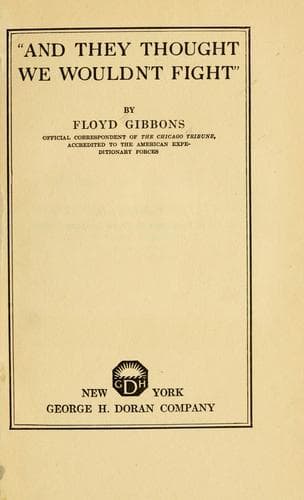
"And they thought we wouldn't fight"Gibbons, Floyd Phillips
History
"And they thought we wouldn't fight"
Gibbons, Floyd Phillips
World War, 1914-1918 -- Campaigns -- Western Front; World War, 1914-1918 -- Personal narratives
The unprepared man had tried to free himself from the overcoat of
pacifism that he had worn so long in safety and in kindliness to his
fellows. The bully, taking advantage of his handicap, had beaten him
brutally. At last the unprepared man had freed himself from the
overcoat and then stood ready not only to defend himself, but to
administer deserved punishment. Then the bully had said:
"Now, wait just a minute. Let's talk this thing over and see if we can't
settle it before I get hurt."
The bully's pockets bulge with the loot he has taken from the man. The
victim's face and head are swollen and bloody and yet the bully invites
him to sit down to a table to discuss the hold-up, the assault, and the
terms of which the loot and the loot only will be returned. The bully
takes it for granted that he is to go unpunished and, more important
still, is to retain the club that he might decide to use again.
The rule of common sense that deals with individuals should be the same
rule that applies to the affairs of nations. No municipal law anywhere
in the world gives countenance to a compromise with a criminal.
International law could be no less moral than municipal law. Prussian
militarism made the world unsafe for Democracy, and for that reason, on
April 6th, 1917, the United States entered the war.
We wanted a decent world in which to live. And the existence of the
Prussian army and its conscienceless masters was incompatible with the
free and peaceful life of the world. We entered the war for an ideal.
That ideal was in the balance when Germany made her 1918 drive for
peace.
Our army in France knew that if peace came with an unwhipped Prussian
army in existence, the world would be just as unsafe for Democracy as it
had ever been. Our army in France wanted no compromise that would leave
Germany in possession of the instruments that had made possible her
crimes against the world. Every man that had shed blood, every man that
had paid the final price, every woman that had shed tears, every
cherished ideal of our one hundred and forty years of national life,
would have been sacrificed in vain, if we had condoned Germany's high
crimes against civilisation and had made a compromise with the criminal.
Woodrow Wilson, President of the United States, spokesman of the Allied
world, sounded the true American note when, in his reply to the
insincere German peace proposals, he referred the German Government to
Marshal Foch, Commander-in-Chief of the Allied armies. War by the sword
was to bring peace by the sword.
And as I write these lines in the last days of October, 1918,
unconditional surrender is the song of the dove of peace perched on our
bayonets as we march into the dawn of victory.
* * * * *
APPENDIX
PERSONNEL OF THE AMERICAN EXPEDITIONARY FORCES IN FRANCE
=1ST ARMY CORPS=
Major Gen. Hunter Liggett, commanding.
Public-domain text, read in full here on John Shaqi.
Reviews
Reviews
No reviews yet
Be the first to share your thoughts on this work.
Elsewhere in the archive
Join the Discussion
Join the discussion
Sign in to leave a comment or review.
Sign InorCreate an account