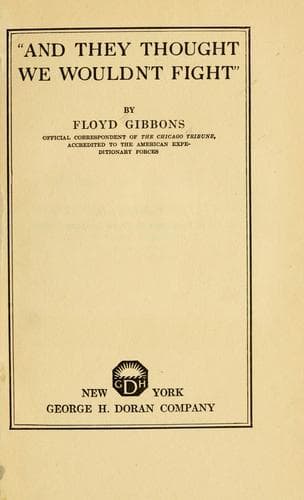
"And they thought we wouldn't fight"Gibbons, Floyd Phillips
History
"And they thought we wouldn't fight"
Gibbons, Floyd Phillips
World War, 1914-1918 -- Campaigns -- Western Front; World War, 1914-1918 -- Personal narratives
One way or the other it meant the "Seventy-fives"--the "Admirable
Seventy-five"--the seventy-five millimetre field pieces that stopped the
Germans' Paris drive at the Marne--the same that gave Little Willie a
headache at Verdun,--the inimitable, rapid firing, target hugging, hell
raising, shell spitting engine of destruction whose secret of recoil
remained a secret after almost twenty years and whose dependability was
a French proverb.
At Valdahon where American artillery became acquainted with the
Seventy-five, the khaki-clad gun crews called her "some cannon." At
seven o'clock every morning, the glass windows in my room at the post
would rattle with her opening barks, and from that minute on until noon
the Seventy-fives, battery upon battery of them, would snap and bark
away until their seemingly ceaseless fire becomes a volley of sharp
cracks which sent the echoes chasing one another through the dark
recesses of the forests that conceal them.
The targets, of course, were unseen. Range elevation, deflection, all
came to the battery over the signal wires that connected the firing
position with some observation point also unseen but located in a
position commanding the terrain under fire.
A signalman sat cross-legged on the ground back of each battery. He
received the firing directions from the transmitter clamped to his ears
and conveyed them to the firing executive who stood beside him. They
were then megaphoned to the sergeants chief of sections.
The corporal gunner, with eye on the sighting instruments at the side of
each gun, "laid the piece" for range and deflection. Number one man of
the crew opened the block to receive the shell, which was inserted by
number two. Number three adjusted the fuse-setter, and cut the fuses.
Numbers four and five screwed the fuses in the shells and kept the
fuse-setter loaded.
The section chiefs, watch in hand, gave the firing command to the gun
crews, and number one of each piece jerked the firing lanyard at ten
second intervals or whatever interval the command might call for. The
four guns would discharge their projectiles. They whined over the damp
wooded ridge to distant imaginary lines of trenches, theoretical
cross-roads, or designated sections where the enemy was supposed to be
massing for attack. Round after round would follow, while telephoned
corrections perfected the range, and burst. The course of each shell was
closely observed as well as its bursting effect, but no stupendous
records were kept of the individual shots. That was "peace time stuff."
Public-domain text, read in full here on John Shaqi.
Reviews
Reviews
No reviews yet
Be the first to share your thoughts on this work.
Join the Discussion
Join the discussion
Sign in to leave a comment or review.
Sign InorCreate an account