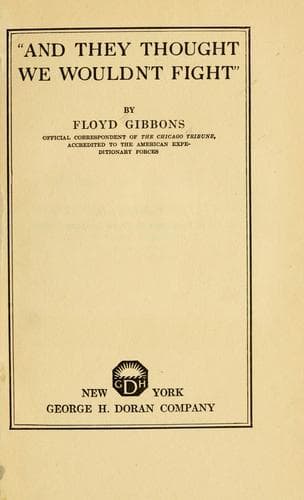
"And they thought we wouldn't fight"Gibbons, Floyd Phillips
History
"And they thought we wouldn't fight"
Gibbons, Floyd Phillips
World War, 1914-1918 -- Campaigns -- Western Front; World War, 1914-1918 -- Personal narratives
These batteries and regiments were learning gunnery and no scarcity of
shells was permitted to interfere with their education. One officer told
me that it was his opinion that one brigade firing at this schooling
post during a course of six weeks, had expended more ammunition than all
of the field artillery of the United States Army has fired during the
entire period since the Civil War. The Seventy-five shells cost
approximately ten dollars apiece, but neither the French nor American
artillery directors felt that a penny's worth was being wasted. They
said cannon firing could not be learned entirely out of a book.
I had talked with a French instructor, a Yale graduate, who had been two
years with the guns at the front, and I had asked him what in his
opinion was the most disconcerting thing that could happen to effect the
morale of new gunners under actual fire. I wanted some idea of what
might be expected of American artillerymen when they made their initial
appearance on the line.
We discussed the effect of counter battery fire, the effect on gun crews
of asphyxiating gas, either that carried on the wind from the enemy
trenches or that sent over in gas shells. We considered the demoralising
influences of aerial attacks on gun positions behind the line.
"They are all bad," my informant concluded. "But they are expected. Men
can stand without complaint and without qualm any danger that is
directed at them by the foe they are fighting. The thing that really
bothers, though, is the danger of death or injury from their own weapons
or ammunition. You see, many times there is such a thing as a faulty
shell, although careful inspection in the munitions plants has reduced
this danger to a percentage of about one in ten thousand.
"At the beginning of the war when every little tin shop all over the
world was converted into a munitions factory to supply the great need of
shells, much faulty ammunition reached the front lines. Some of the
shells would explode almost as soon as they left the gun. They are
called shorts. The English, who had the same trouble, call them 'muzzle
bursts.'
"Sometimes the shell would explode in the bore of the cannon, in which
case the cannoneers were usually killed either by pieces of the shell
itself or bits of the cannon. The gunners have to sit beside the cannon
when it is fired, and the rest of the gun crew are all within eight feet
of it. If there is an explosion in the breech of the gun, it usually
wipes out most of the crew. A muzzle burst, or a breech explosion, is
one of the most disconcerting things that could happen in a battery.
Public-domain text, read in full here on John Shaqi.
Reviews
Reviews
No reviews yet
Be the first to share your thoughts on this work.
Join the Discussion
Join the discussion
Sign in to leave a comment or review.
Sign InorCreate an account