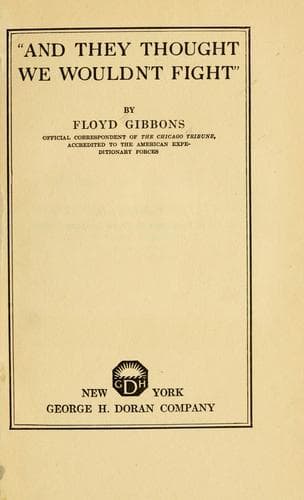
"And they thought we wouldn't fight"Gibbons, Floyd Phillips
History
"And they thought we wouldn't fight"
Gibbons, Floyd Phillips
World War, 1914-1918 -- Campaigns -- Western Front; World War, 1914-1918 -- Personal narratives
While the solid rock walls of the black bore reverberate with the echoes
from our exhaust, we emerge on a road that turns sharply to the left and
hugs a cliff. Below winds a broad river that looks like mother of pearl
in the moonlight. The mountain walls on either side rise at angles
approximating 45 degrees, and in the light their orderly vineyards look
like the squares on a sloping checkerboard. In front of us and to the
right the flanking ridges converge to a narrow gorge through which the
river Doub runs to loop the town.
Commanding this gorge from the crests of the two rocky heights are
sinister sentinels whose smooth, grey walls and towers rise sheer from
the brink of the cliffs. The moonlight now catching the ramparts of the
em-battlements splashes them with strokes of white that seem ever
brighter in contrast with the darker shadows made by projecting portions
of the walls. Spaniard and Moor knew well those walls, and all the
kingly glory that hurried France to the reign of terror has slept within
their shadows.
Our way down the cliff side is hewn out of the beetling rock. To our
left, a jagged wall of rock rises to the sky. To our right, a step,
rock-tumbled declivity drops to the river's edge.
The moonlight brings funny fancies, and our yellow headlights, wavering
in concentric arcs with each turn of the course, almost seem to glint on
the helmets and shields of the spear-bearing legionaries that marched
that very way to force a southern culture on the Gauls. We slow down to
pass through the rock-hewn gate that once was the Roman aqueduct
bringing water down from mountain springs to the town.
Through the gate, a turn to the left and we reach the black bottom of
the gorge untouched by the rising moon. We face a blast of wind that
slows our speed and brings with it the first big drops of rain. We stop
at the "Octroi" and assure the customs collector that we are military,
and that we carry no dutiable wine, or beans or wood into the town.
Yet another gate, built across the narrow road between the cliff and the
river, and we enter the town. It has been raining and the cobblestones
are slippery. They shine in the gleams of pale light that come from the
top-heavy street lamps. Gargoyle water spouts drip drainage from the
gables of moss-speckled tiles.
We pass a fountain that the Romans left, and rounded arches further on
show where the hooded Moor wrote his name in masonry. Barred windows and
stone balconies projecting over the street take one's mind off the
rattling motor and cause it to wander back to times when serenading
lovers twanged guitars beneath their ladies' windows and were satisfied
with the flower that dropped from the balcony.
Public-domain text, read in full here on John Shaqi.
Reviews
Reviews
No reviews yet
Be the first to share your thoughts on this work.
Elsewhere in the archive
Join the Discussion
Join the discussion
Sign in to leave a comment or review.
Sign InorCreate an account