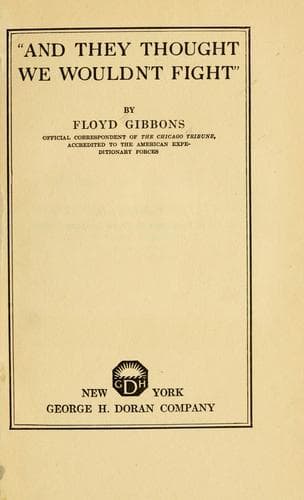
"And they thought we wouldn't fight"Gibbons, Floyd Phillips
History
"And they thought we wouldn't fight"
Gibbons, Floyd Phillips
World War, 1914-1918 -- Campaigns -- Western Front; World War, 1914-1918 -- Personal narratives
The streets are wet and dark now and through their narrow windings our
headlights reveal tall figures in slickers or khaki overcoats topped by
peaked felt hats with the red cords of American artillerymen. Their
identification is a surprise to the dreamer, because one rather expects
these figures to sulk in the deeper shadows and screen their dark,
bearded faces with the broad brims of black felt hats or muffle
themselves to the chin in long, flowing black cloaks that hide rapiers
and stilettos and other properties of mediaeval charm.
We dine in a room three hundred years old. The presence of our
automobile within the inner quadrangle of the ancient building jars on
the sense of fitness. It is an old convent, now occupied by irreligious
tenants on the upper three floors, restaurants and estaminets on the
lower floor. These shops open on a broad gallery, level with the
courtyard, and separated from it only by the rows of pillars that
support the arches. It extends around the four sides of the court.
Centuries ago shrouded nuns, clasping beads or books of office, walked
in uncommunicative pairs and mumbled their daily prayers beneath these
time-worn arches, and to-night it affords a promenade for officers
waiting for their meals to be served at madame's well laid tables
within.
Madame's tables are not too many. There is not the space economy of an
American cafe, where elbows interlock and waiters are forced to navigate
fearsome cargoes above the diners' heads. Neither is there the
unwholesome, dust-filled carpet of London's roast beef palaces.
Madame's floor is bare, but the wood has stood the scrubbings of years,
and is as spotless as grass-dried linen. The high ceiling and the walls
are of white stucco. In bas-relief are clusters of heraldic signs, of
bishops' crooks and cathedral keys, of mounted chargers and dying
dragoons, of miter and crown, and trumpet and shield, and cross.
Large mirrors, circled with wreaths of gilded leaves, adorn both end
walls, and beneath one of them remains an ornate fireplace and
mantelpiece of bologna coloured marble, surmounted with a gilt cock of
wondrous design. Beneath the other mirror madame has placed her buffet,
on which the boy who explores the dusty caves below places the cobwebbed
bottles of red wine for the last cork pulling. Large gold chandeliers,
dangling with glass prisms, are suspended from high ceiling and flood
the room with light, against which the inner shutters of the tall
windows must be shut because of danger from the sky.
There is colour in that room. The Roman conquerors would have found it
interesting. If former armed occupants of the old town could have
paraded in their ancient habiliments through the room like a procession
from the martial past, they would have found much for their attention in
this scene of the martial present. American khaki seems to predominate,
although at several tables are Canadian officers in uniforms of the same
colour but of different tailoring.
Public-domain text, read in full here on John Shaqi.
Reviews
Reviews
No reviews yet
Be the first to share your thoughts on this work.
Elsewhere in the archive
Join the Discussion
Join the discussion
Sign in to leave a comment or review.
Sign InorCreate an account