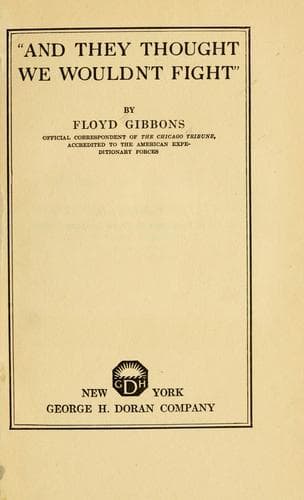
"And they thought we wouldn't fight"Gibbons, Floyd Phillips
History
"And they thought we wouldn't fight"
Gibbons, Floyd Phillips
World War, 1914-1918 -- Campaigns -- Western Front; World War, 1914-1918 -- Personal narratives
Half of the statues on the broad facade of the cathedral had been
broken, and now the niches afforded domiciles for families of pigeons.
On the ground, in a careless pile, to one side of the frontal arch, was
an ignominious pile of miscellaneous arms and legs and heads of
sculptured figures, resting there in anything but saintly dignity. Two
of our young artillerymen were standing in front of the cathedral
surveying it.
"Certainly is in need of repairs," said one of them. "I'll bet they
haven't done no bricklaying or plumbing on this place since before the
Civil War."
"That ain't hardly the right way to treat old Saints," replied his
companion, referring to the pile of broken statuary. "Seems like they
ought to cement the arms and legs and heads back on those old boys and
old girls and put them back on their pedestals. I guess, though, there
ain't nobody living to identify the pieces, so they could get the right
arms and heads on the right bodies."
Our battery had among its drivers an old timer who might have been
called a historian. His opinion held weight in the organisation. He
professed to be able to read American ball scores and war news out of
French newspapers, a number of which he always carried. Later that day,
I heard him lecturing the cathedral critics on their lack of
appreciation of art and history.
"New things ain't art," he told them; "things has got to be old before
they are artistic. Nobody'd look at the Venus dee Milo if she had all
her arms on. You never hear nobody admiring a modern up-to-date castle
with electric lighting and bath tubs in it. It simply ain't art.
"Now, this cathedral is art. This country around here is just full of
history. Here's where whole book stores of it was written. Why, say,
there was batteries of artillery rolling through this country a million
years ago. It was right around here that Napoleon joined forces with
Julius Caesar to fight the Crusaders. This here is sacred ground."
In the evening, a number of the battery, located the _buvette_ that
carried across its curtained front the gold lettered sign _bar
Parisian_. It was a find. Some thirty American artillerymen crowded
around the tables.
Cigarette smoke filled the low-ceilinged room with blue layers, through
which the lamp light shone. In one corner stood a mechanical piano which
swallowed big copper sous and gave out discord's metallic melody. It was
of an American make and the best number on its printed programme was
"Aren't you Coming Back to Old Virginia, Molly?" Sous followed sous into
this howitzer of harmony and it knew no rest that night. Everybody
joined in and helped it out on the choruses.
Public-domain text, read in full here on John Shaqi.
Reviews
Reviews
No reviews yet
Be the first to share your thoughts on this work.
Elsewhere in the archive
Join the Discussion
Join the discussion
Sign in to leave a comment or review.
Sign InorCreate an account