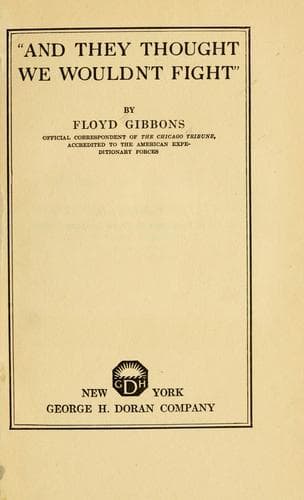
"And they thought we wouldn't fight"Gibbons, Floyd Phillips
History
"And they thought we wouldn't fight"
Gibbons, Floyd Phillips
World War, 1914-1918 -- Campaigns -- Western Front; World War, 1914-1918 -- Personal narratives
In the long, narrow, low-ceilinged shelter which completely tunnelled
the road at a depth of twenty feet, two twenty-year-old Americans were
hugging a brazier filled with charcoal. In this dugout was housed a
group from a machine gun battalion, some of whose members were snoring
in a double tier of bunks on the side.
Deep trenches at the other end of the dugout led to the gun pits, where
this new arm of the service operated at ranges of two miles. These
special squads fired over the heads of those in front of them or over
the contours of the ground and put down a leaden barrage on the front
line of the Germans. The firing not only was indirect but was without
correction from the rectifying observation, of which the artillery had
the benefit by watching the burst of their missiles.
Regaining the road, we walked on through the ruins on the edge of the
village of Seicheprey, where our way led through a drunken colony of
leaning walls and brick piles.
Here was the battalion headquarters, located underneath the old stones
of a barn which was topped by the barest skeleton of a roof. What had
been the first floor of the structure had been weighted down heavily
with railroad iron and concrete to form the roof of the commander's
dugout. The sides of the decrepit structure bulged outward and were
prevented from bursting by timber props radiating on all sides like the
legs of a centipede. A mule team stood in front of the dugout.
"What's that?" the whispering lieutenant inquired in hushed tones from a
soldier in the road, as he pointed over the mules to the battalion
headquarters.
"What's what?" the soldier replied without respect.
The obscurity of night is a great reducer of ranks. In the mist officer
and man look alike.
"Why, that?" repeated "Whispering Willie" in lower, but angrier tones.
"What's that there?" he reiterated, pointing at the mules.
"Can't you see it's mules?" replied the man in an immoderate tone of
voice, betraying annoyance.
We were spared what followed. The lieutenant undoubtedly confirmed his
rank, and the man undoubtedly proffered unto him the respect withheld by
mistake. When "Whispering Willie" joined us several minutes later in the
dugout, his helmet rode on the back of his head, but his dignity was on
straight.
The Battalion Commander, Major Griffith, was so glad to see us that he
sent for another bottle of the murky grey water that came from a well on
one side of a well populated graveyard not fifty yards from his post.
"A good night," he said; "haven't seen it so quiet in three years. We
have inter-battalion relief on. Some new companies are taking over the
lines. Some of them are new to the front trenches and I'm going out with
you and put them up on their toes. Wait till I report in."
He rang the field telephone on the wall and waited for an answer. An oil
lamp hung from a low ceiling over the map table. In the hot, smoky air
we quietly held our places while the connection was made.
Public-domain text, read in full here on John Shaqi.
Reviews
Reviews
No reviews yet
Be the first to share your thoughts on this work.
Elsewhere in the archive
Join the Discussion
Join the discussion
Sign in to leave a comment or review.
Sign InorCreate an account