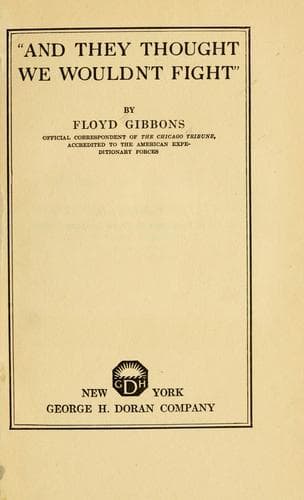
"And they thought we wouldn't fight"Gibbons, Floyd Phillips
History
"And they thought we wouldn't fight"
Gibbons, Floyd Phillips
World War, 1914-1918 -- Campaigns -- Western Front; World War, 1914-1918 -- Personal narratives
"Halt!" The sharp command, coming sternly but not too loud from
somewhere in the adjacent mist, brought the party to a standstill in the
open on the edge of the village. We remained notionless while the Major
advanced upon command from the unseen. He rejoined us in several minutes
with the remark that the challenge had come from one of his old men, and
he only hoped the new companies taking over the line that night were as
much on their jobs.
"Relief night always is trying," the Major explained. "Fritz always
likes to jump the newcomers before they get the lay of the land. He
tried it on the last relief, but we burnt him."
While talking the Major was leading the way through the first trench I
had ever seen above the surface of the ground. The bottom of the trench
was not only on a level with the surrounding terrain, but in some places
it was even higher. Its walls, which rose almost to the height of a
man's head, were made of large wicker woven cylinders filled with earth
and stones.
Our guide informed us that the land which we were traversing was so low
that any trench dug in the ground would simply be a ditch brimful of
undrainable water, so that, inasmuch as this position was in the first
line system, walls had been built on either side of the path to protect
passers-by from shell fragments and indirect machine gun fire. We
observed one large break where a shell had entered during the evening.
Farther on, this communicating passage, which was more corridor than
trench, reached higher ground and descended into the earth. We reeled
through its zig-zag course, staggering from one slanting corner to
another.
The sides were fairly well retained by French wicker work, but every
eighth or tenth duck board was missing, making it necessary for trench
travellers to step knee-deep in cold water or to jump the gap.
Correspondent Eyre, who was wearing shoes and puttees, abhorred these
breaks.
We passed the Major's post of command, which he used during intense
action, and some distance on, entered the front line. With the Major
leading, we walked up to a place where two Americans were standing on a
firing step with their rifles extended across the parapet. They were
silently peering into the grey mist over No Man's Land. One of them
looked around as we approached. Apparently he recognised the Major's
cane as a symbol of rank. He came to attention.
"Well," the Major said, "is this the way you let us walk up on you? Why
don't you challenge me?"
"I saw you was an officer, sir," the man replied.
"Now, you are absolutely sure I am YOUR officer?" the Major said slowly
and coldly, with emphasis on the word "your." "Suppose I tell you I am a
German officer and these men behind me are Germans. How do you know?"
With a quick movement the American brought his rifle forward to the
challenge, his right hand slapping the wooden butt with an audible
whack.
Public-domain text, read in full here on John Shaqi.
Reviews
Reviews
No reviews yet
Be the first to share your thoughts on this work.
Elsewhere in the archive
Join the Discussion
Join the discussion
Sign in to leave a comment or review.
Sign InorCreate an account