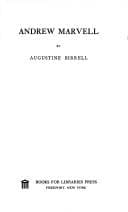
Authors, English -- Early modern, 1500-1700 -- Biography; Marvell, Andrew, 1621-1678
"But though he came of a good mother, he had a very ill sire. He was
a man bred toward the Law, and betook himself, as his best practice,
to be a sub-committee-man, or, as the stile ran, one of the Assistant
Committee in Northamptonshire. In the rapine of that employment, and
what he got by picking the teeth of his masters, he sustain'd himself
till he had raked together some little estate. And then, being a man
for the purpose, and that had begun his fortune out of the
sequestration of the estates of the King's Party, he, to perfect it
the more, proceeded to take away their lives; not in the hot and
military way (which diminishes always the offence), but in the cooler
blood and sedentary execution of an High Court of Justice.
Accordingly he was preferr'd to be one of that number that gave
sentence against the three Lords, Capel, Holland, and Hamilton, who
were beheaded. By this learning in the Law he became worthy of the
degree of a serjeant, and sometimes to go the Circuit, till for
misdemeanor he was petition'd against. But for a taste of his
abilities, and the more to reingratiate himself, he printed, in the
year 1650, a very remarkable Book, called 'The Government of the
People of England, precedent and present the same. _Ad subscribentes
confirmandum, Dubitantes informandum, Opponentes convincendum_; and
underneath _Multa videntur quae non sunt, multa sunt quae non
videntur_. Under that ingraven two hands joyn'd, with the motto, _Ut
uniamur_; and beneath a sheaf of arrows, with this device, _Vis unita
fortior_; and to conclude, _Concordia parvae res crescunt discordia
dilabuntur_.' A most hieroglyphical title, and sufficient to have
supplied the mantlings and atchievements of the family! By these
parents he was sent to Oxford, with intention to breed him up to the
ministry. There in a short time he enter'd himself into the company
of some young students who were used to fast and pray weekly
together; but for their refection fed sometimes on broth, from whence
they were commonly called Grewellers; only it was observed that he
was wont still to put more graves than all the rest in his porridge.
And after that he pick'd acquaintance not only with the brotherhood
at Wadham Colledge, but with the sisterhood too, at another old
Elsibeth's, one Elizabeth Hampton's, a plain devout woman, where he
train'd himself up in hearing their sermons and prayers, receiving
also the Sacrament in the house, till he had gain'd such proficience,
that he too began to exercise in that Meeting, and was esteem'd one
of the preciousest young men in the University. But when thus, after
several years' approbation, he was even ready to have taken the
charge, not of an 'admiring drove or heard,' as he now calls them,
but of a flock upon him, by great misfortune the King came in by the
Public-domain text, read in full here on John Shaqi.
Reviews
Reviews
No reviews yet
Be the first to share your thoughts on this work.
Elsewhere in the archive
Join the Discussion
Join the discussion
Sign in to leave a comment or review.
Sign InorCreate an account